
On this page
Matching the piston to its weight set
Send the piston and weight-set identifiers, pressure mode and the reference level used on the bench. If the request is for generated pressure, distinguish it from a request to determine the effective area of the piston-cylinder unit.
An extra weight on the bench may be marked with the same pressure as a missing weight from another set. Check the piston assignment first. The force from a given mass produces different pressures on pistons with different effective areas.
Specifications and service checks
On a low-pressure air balance, a light carrier may generate part of the pressure before any loose mass is added. Identify the carrier paired with the piston. This matters when the first pressure in a weight schedule cannot be reproduced from the loose pieces alone.
- Range and configuration
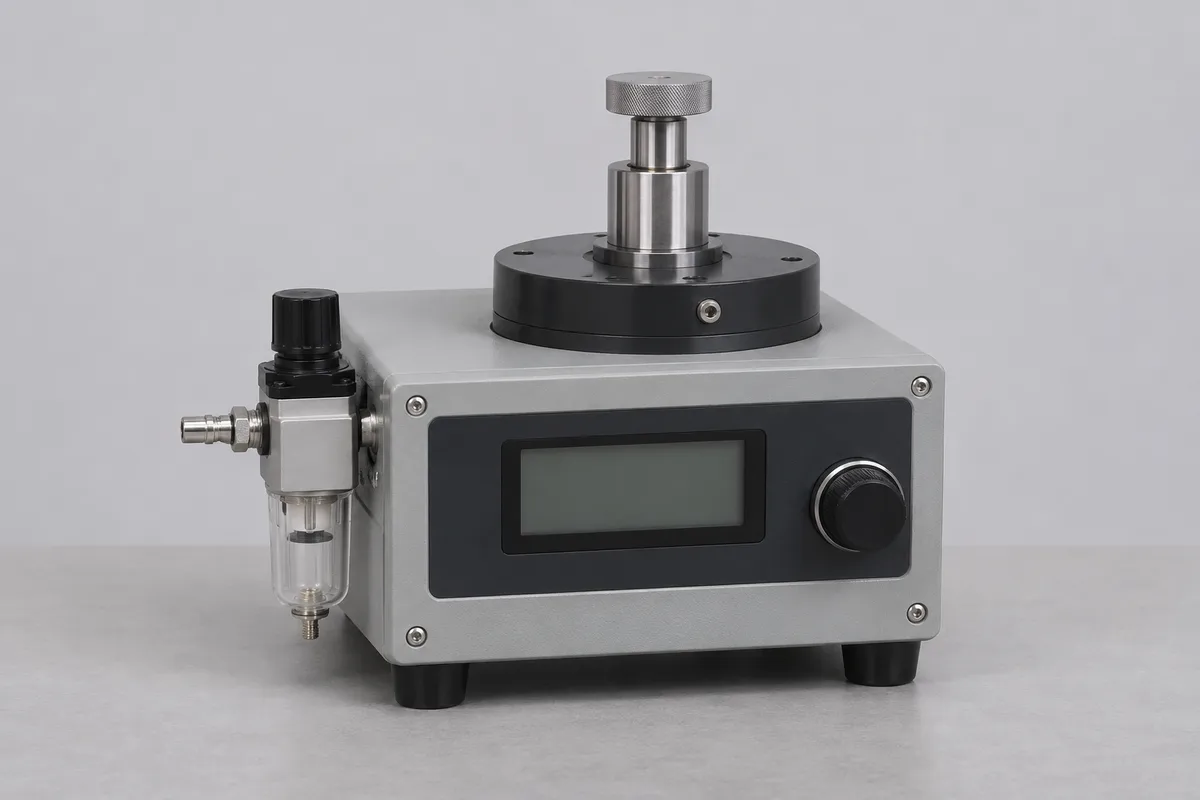
- The Fluke PG7601 accepts piston-cylinder assemblies with nominal pressure increments including 10, 50 and 200 kPa per kilogram. The fitted assembly and the applied mass determine the actual working pressure.
- Manufacturers and models
- Fluke Calibration's PG7000 family includes gas-operated piston gauges. Confirm the piston-cylinder and mass-set identities separately.
- What we check
- The comparison concerns the pressure generated by the assembly. A cross-float against another pressure balance can establish the effective area and its pressure dependence.
- Reference equipment and accuracy
- Use a traceable piston-cylinder assembly, calibrated masses and temperature measurement. Local gravity and effective area both enter the uncertainty.
- When to repeat the check
- Review changes in piston behaviour and mass-set history. Certificate dates for the mass set and the assembly may differ.
Technical references Fluke PG7601 piston gauge