
On this page
Head, gas setting and pressure at changeover
Give us the head and controller models, cable, gas setting and pressures you normally measure in the chamber. If another gauge covers part of the same range, note where the control system switches from one instrument to the other.
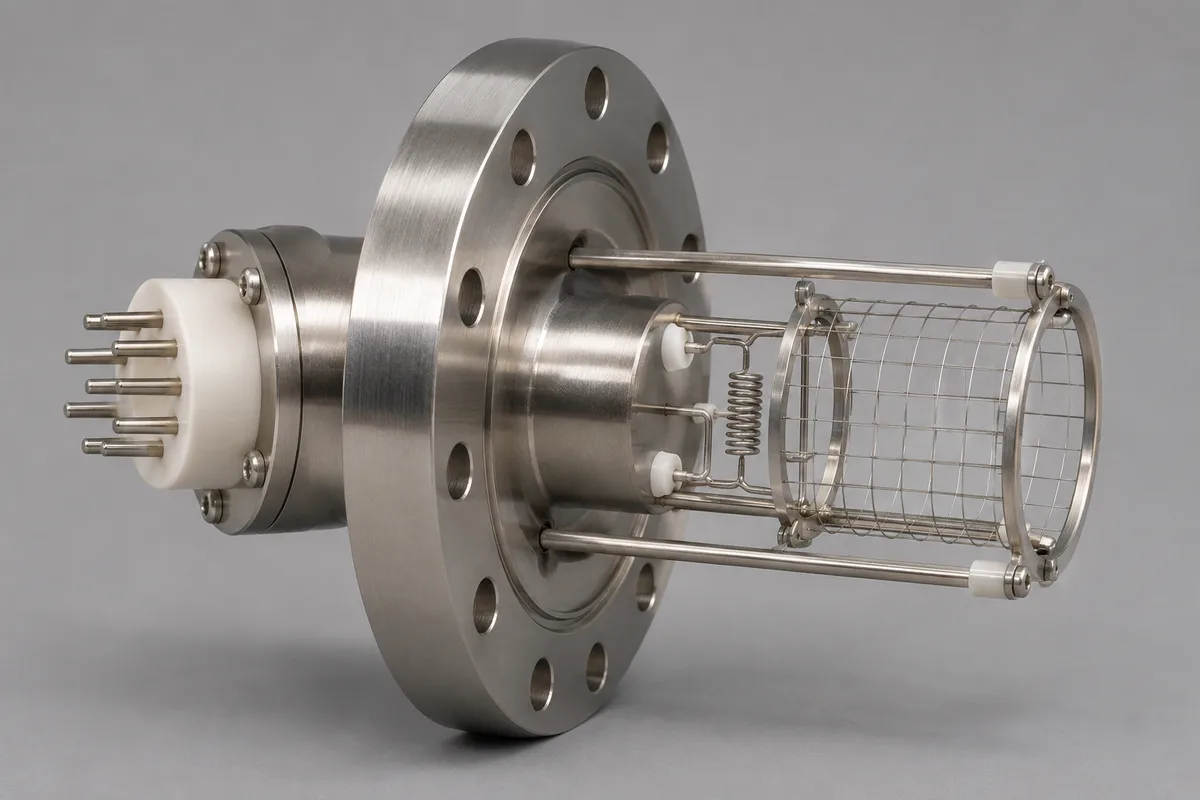
Extractor gauges
Identify the head, controller, cable and gas for which readings are required. Supply the manufacturer's operating and verification information, including the requested pressure interval. RTS calibrates the head and controller at the specified gas and pressure conditions. Record the requested low-pressure points explicitly so the report identifies the interval measured.
Specifications and service checks
In a multi-head vacuum station the display may show whichever head is selected automatically. For a base-pressure query, supply the active channel name from the run log. The make on the front panel alone can identify the controller while leaving the measuring head uncertain.
- Range and configuration
- Leybold specifies the IE 514 head from about 10⁻¹² to 10⁻⁴ mbar. The actual comparison range must be agreed separately for the gas and controller used.
- Manufacturers and models
- Leybold IE 514 is an extractor-type high-vacuum gauge.
- What we check
- A comparison is made against a vacuum reference in a suitable system. The report should identify the gas and the pressure range over which sensitivity was determined.
- Reference equipment and accuracy
- The reference must have traceable sensitivity in the same vacuum range. Chamber background and the complete head-controller pairing contribute to the uncertainty.
- When to repeat the check
- Review after filament replacement, contamination or a change of head. The sensitivity history is more useful than calendar age alone.
Technical references Leybold vacuum gauge catalogue