
On this page
Drum speed and the revolution counter
A counter can stop a drum at exactly 100 turns while a slow drive takes longer than the normal run. If your procedure specifies both turns and speed, ask for both results and identify the drum on a twin unit. When drum dimensions or the internal baffle are also due for inspection, send the drawing or method. We can report those features against the drum that was fitted.
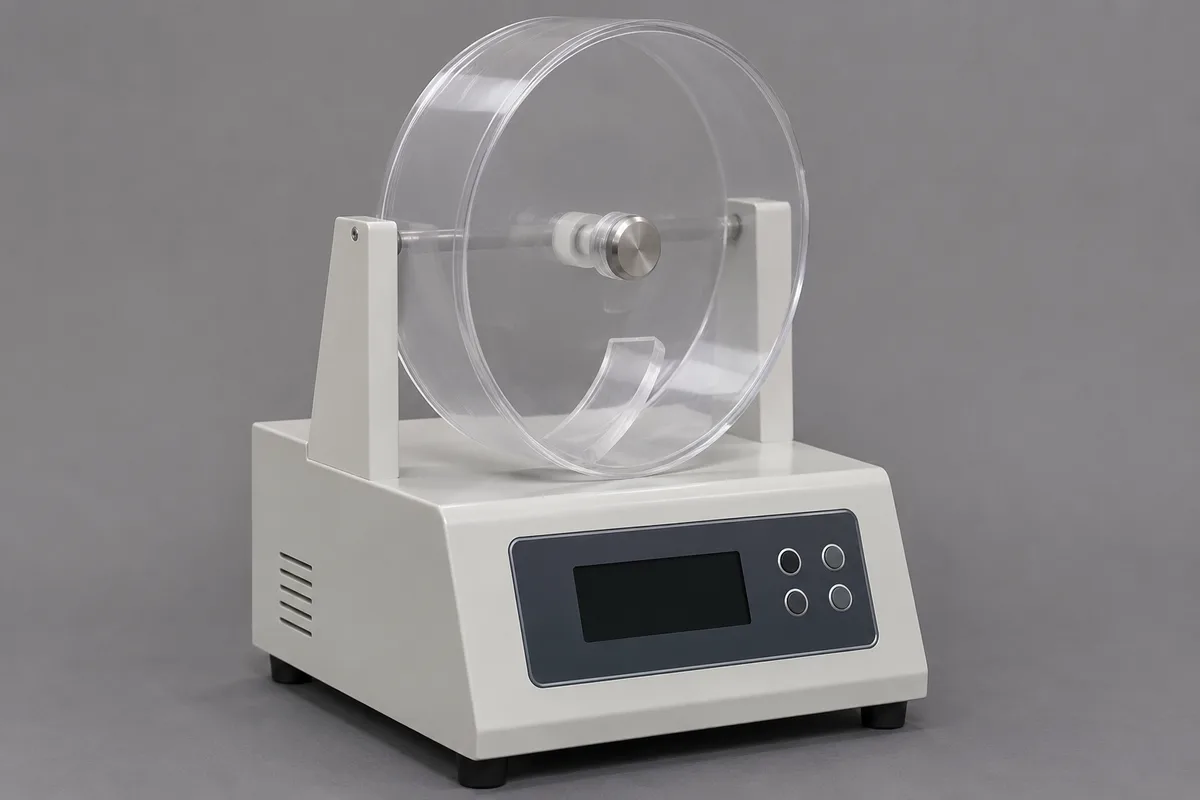
Friability tester rotation and drum identity
The balance used to compare specimen mass is a separate instrument and should have its own calibration record. State which components are included in the enquiry. Verifying a rotation count does not determine the friability result of an untested tablet batch.
Specifications and service checks
A timer running for four minutes and a drum completing 100 turns over those four minutes describe an average of 25 rpm. If both elapsed time and total revolutions are used for equipment release, ask for both observations. Matching one value cannot establish the other.
- Range and configuration
- ERWEKA’s TAR II allows the requested count to be set from 1 to 9,999 revolutions. Count, rotational speed and elapsed time describe different functions.
- Manufacturers and models
- ERWEKA’s TAR II is available in one- and two-drum configurations.
- What we check
- Compare observed revolutions and run time with the indicated or programmed values. Where speed is required, measure it independently and identify which drum was fitted.
- Reference equipment and accuracy
- Use a calibrated timebase and a suitable rotation counter or tachometer. Weighing before and after a product test requires a separately calibrated balance.
- When to repeat the check
- Use service and check records to establish recall. A replaced drum drive or counter sensor should prompt another comparison.
Technical references ERWEKA TAR II data sheet