
On this page
Scale angle and the manometer liquid
Give the scale setting or angle in use and the liquid marking on the instrument. Include the level reference and mounting orientation for a fixed unit. If more than one inclination is used, request results for each scale position that supports a process decision.
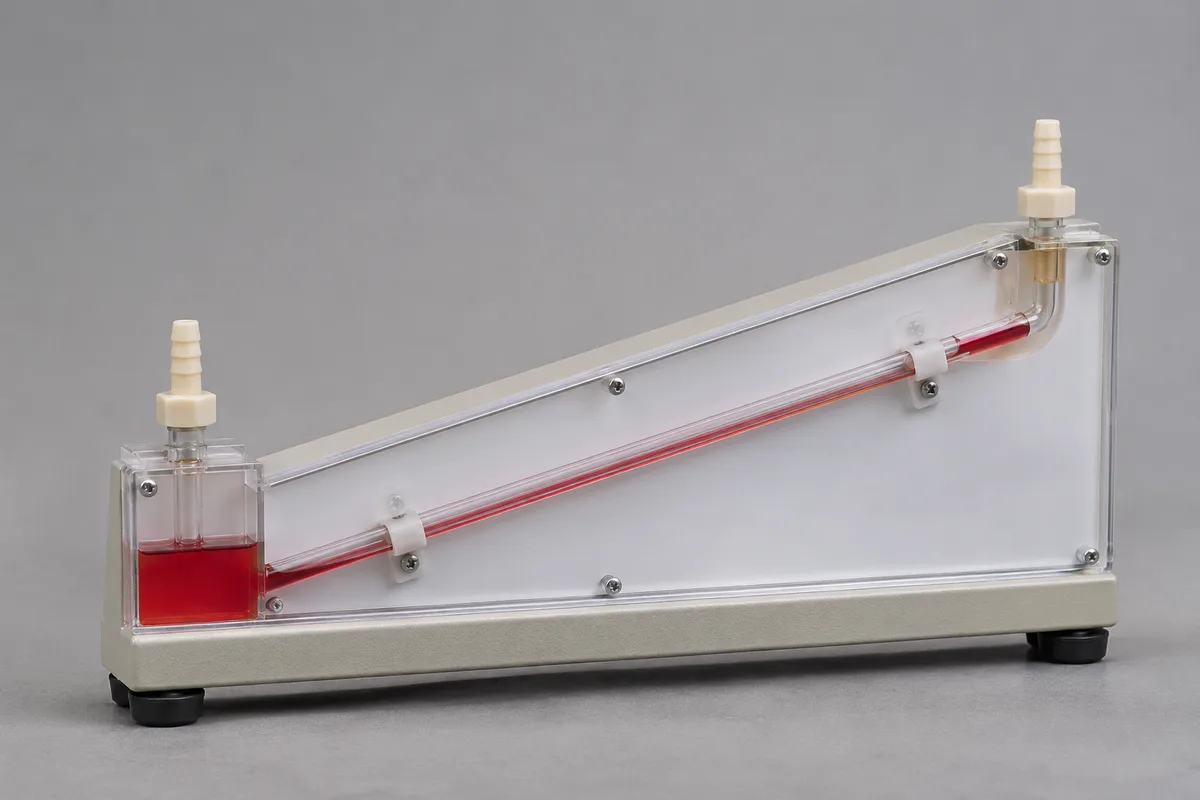
Changing the inclination changes the relationship between movement along the tube and the vertical head. On an adjustable manometer, photograph the selected scale, angle setting and level reference before moving it. A tube serial number will not recover those settings later.
Specifications and service checks
If a scale is already graduated in pressure, the observer should read those marked units. If the worksheet instead uses distance along the slope, the tube inclination enters the conversion to vertical head. Say which reading the operator actually records.
- Range and configuration
- A longer scale for a small height change improves readability but relies on correct levelling and the specified indicating liquid.
- Manufacturers and models
- Dwyer Mark II instruments use an inclined liquid column for increased scale length at low pressure differences.
- What we check
- Compare graduations with controlled differential pressures. Record the liquid and observe the designated meniscus with the instrument level.
- Reference equipment and accuracy
- Use a calibrated low-pressure reference or a characterised liquid-column standard. Density, reference level and reading angle contribute to uncertainty.
- When to repeat the check
- Check level and liquid condition whenever the manometer is moved or refilled.
Technical references Series Mark II Molded Plastic Manometers