
On this page
Drive head and working speed
List any interchangeable drive head and the settings normally recorded in the laboratory. If verification concerns a timed programme, include the start event and duration separately. Reporting the attachment and the observation point keeps comparisons meaningful after a stirrer is moved.
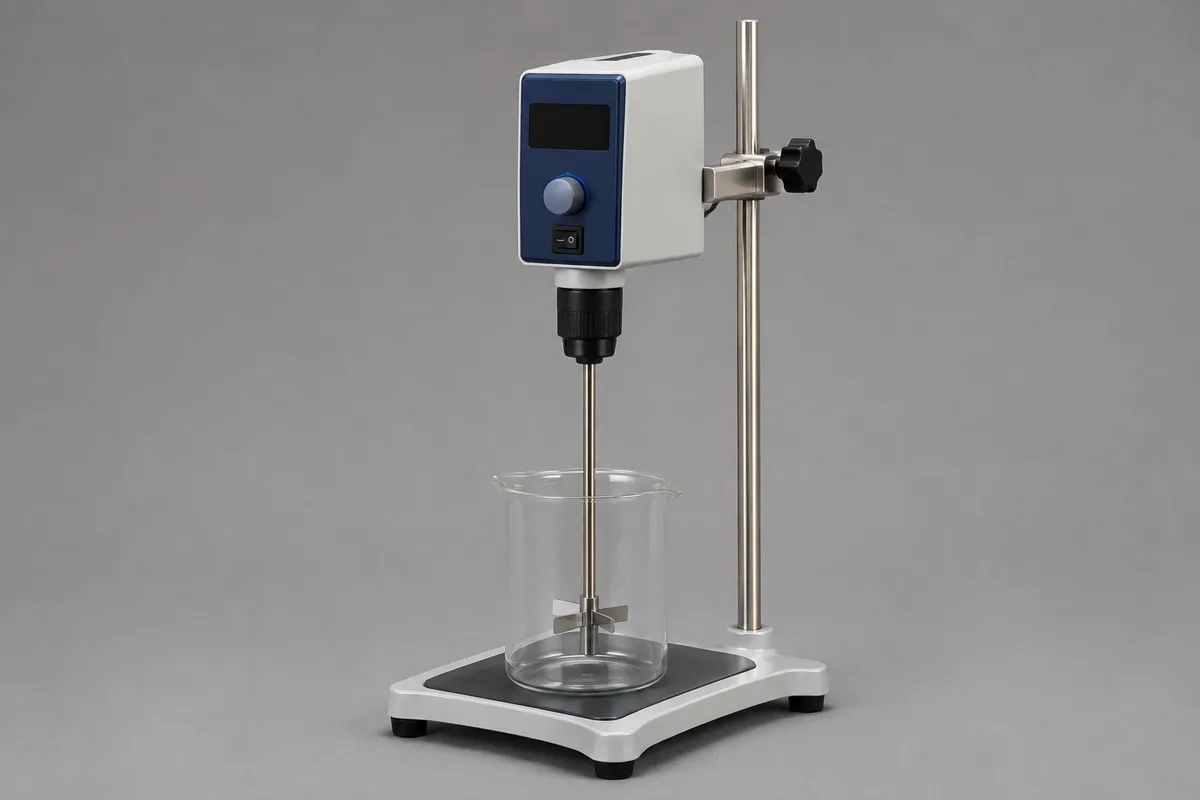
A magnetic stirrer and an overhead stirrer can both carry an rpm dial. On an overhead unit the motor, coupling and shaft identify the rotating assembly. On a magnetic unit the selected setting is distinct from the observed motion of the stir bar. Tell us which indication or motion your equipment procedure actually checks.
Laboratory stirrer drive and temperature functions
Specify the model and whether speed, external probe indication, plate temperature or several quantities need records. A control setting is not necessarily the liquid temperature or stir-bar speed. Include the normal accessory and vessel arrangement so the proposed comparison refers to a defined setup.
Specifications and service checks
A motor display in rpm may stay steady while the stirring attachment is changed. If a speed check must represent the installed arrangement, identify the spindle or stirring accessory and any selected transmission ratio. This keeps the display comparison tied to the drive configuration used at the bench.
- Range and configuration
- The IKA KS 260 basic has a 10 mm orbital stroke and a maximum speed of 500 rpm. The EUROSTAR 20 digital is an overhead stirrer with shaft speeds up to 2,000 rpm.
- Manufacturers and models
- IKA supplies KS orbital shakers and EUROSTAR overhead stirrers. The motion type on the nameplate is a useful first distinction.
- What we check
- Compare the indicated motion with a reference speed measurement at the working points. Specify shaft rotation or orbital cycles and identify the fitted platform or attachment.
- Reference equipment and accuracy
- Use a calibrated tachometer, strobe or cycle counter that suits the observed movement. A calibrated timer supports any separate run-time comparison.
- When to repeat the check
- A worn coupling or drive service can change the relationship between indication and movement. Review speed at a familiar setting between scheduled visits.
Technical references IKA EUROSTAR 20 digital technical data · IKA KS 260 basic technical data