
On this page
The sieve stack, amplitude and run time
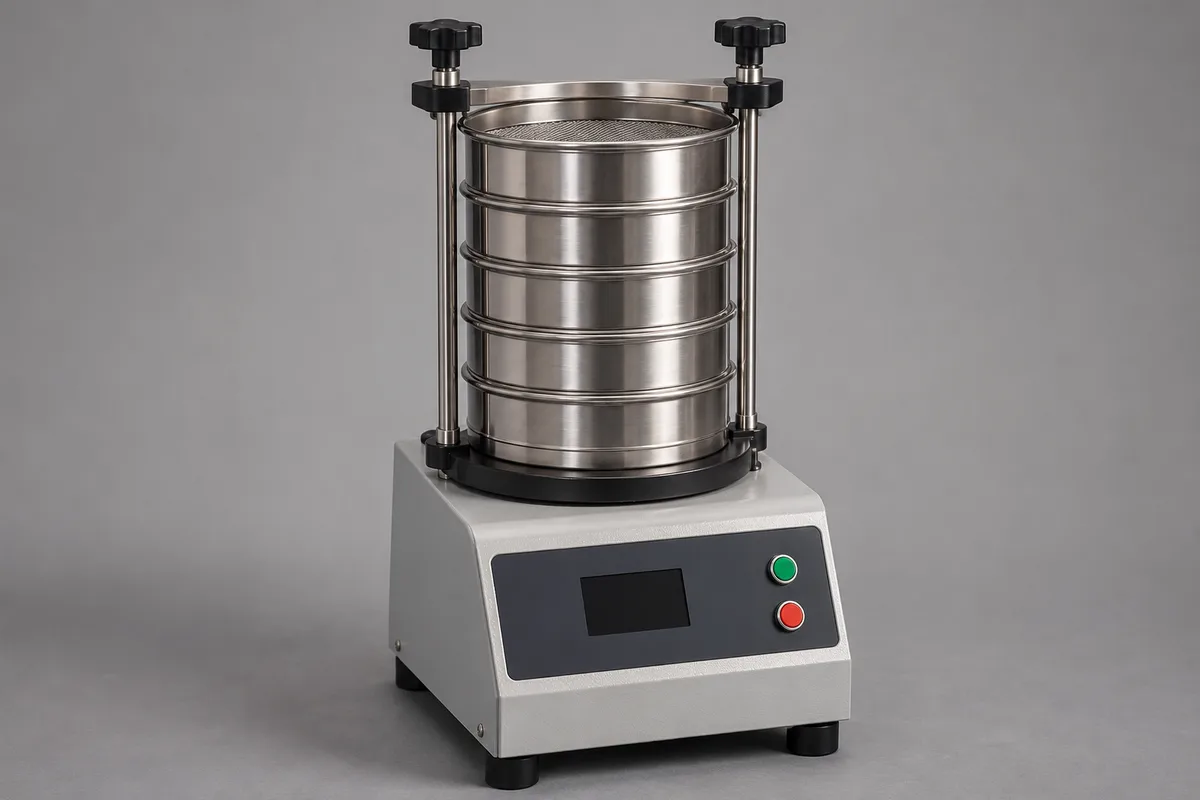
Consider a shaker run with eight sieves and a collecting pan. If you usually remove four sieves for another product, say which stack you want on the machine for the motion check. Copy the amplitude setting exactly as the panel shows it. A dial position of ‘3’ is not a claim of 3 mm unless the maker assigns that unit. Give the usual run length for the timer comparison.
Sieve shaker drive versus sieve apertures
Identify the drive model and whether the request concerns time, vibration or another specified motion parameter. List the sieve stack separately if its apertures also require examination. A shaker timer result does not establish the dimensions or condition of the individual sieve meshes.
Specifications and service checks
If a technician changes the sieve stack height, the same timer and motion setting can be used with a different mechanical load. Identify the typical stack and whether the job concerns elapsed time, oscillation rate or amplitude. A timer-only check addresses just the first quantity.
- Range and configuration
- RETSCH specifies 0.20–3.00 mm digital amplitude on its AS 200 control. The movement of the shaker and the nominal openings of the sieves require different measurements.
- Manufacturers and models
- RETSCH’s AS 200 control is a vibratory sieve shaker with electronic controls.
- What we check
- Compare the shaker’s timer with a time reference. For a requested amplitude measurement, identify the movement definition and where it is measured on the stack.
- Reference equipment and accuracy
- Use a traceable time reference and a suitable displacement or vibration reference for the specified motion. A sieve aperture certificate covers a different component.
- When to repeat the check
- Review after drive or suspension work and when an in-house comparison shows a change. Maintain individual aperture records for the sieve stack.
Technical references RETSCH AS 200 control