
On this page
Upper opening, lower opening and base
If the small opening has been knocked out of round, tell us whether the concern is one diameter or the shape of the rim. A sketch can show the two directions where the readings are needed. Include the base plate or rod only when they are part of the requested checks, and identify the separate scale used to measure slump or spread.
Slump cone dimensions
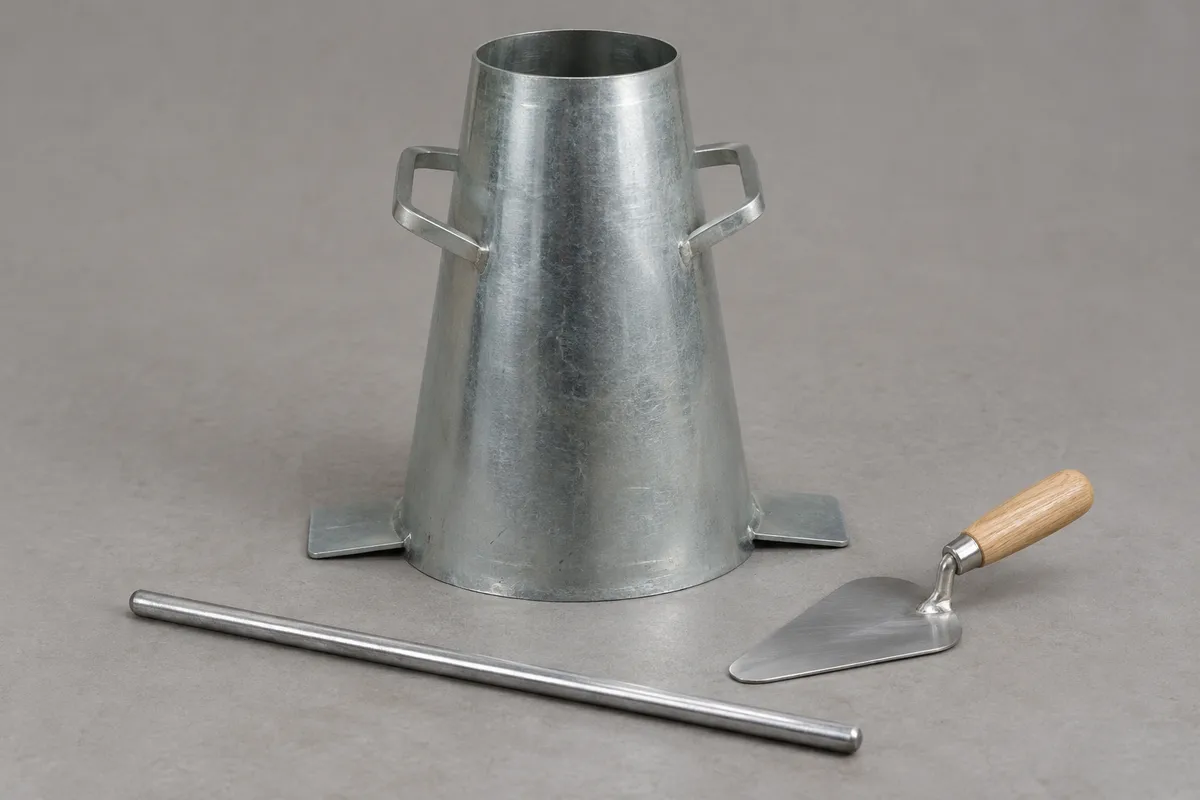
Identify the cone, base and tamping rod individually if all are included. Note distorted edges or a base that no longer sits securely. A dimensional examination concerns the apparatus; a slump reading on fresh concrete still depends on the specified sampling and test procedure.
Specifications and service checks
Measure the openings with the cone identified in its normal assembled condition. A lip dented during transport may affect one direction more than another, so mark its position as well as the nominal opening.
- Range and configuration
- The C181 height is 300 mm, with 100 mm and 200 mm end diameters. The cone itself has no continuous measurement scale.
- Manufacturers and models
- Matest C181 is a conventional slump cone. Humboldt lists a steel slump cone for fresh-concrete testing.
- What we check
- Measure both openings and height, checking more than one diameter to reveal distortion. Report the identification of any supplied base and rule separately.
- Reference equipment and accuracy
- Use calibrated internal length and height references with adequate reach. Compare the results with the dimensional limits in the requested test method.
- When to repeat the check
- Inspect for dents before each use. A damaged rim is a reason to remeasure the cone ahead of its scheduled inspection.
Technical references Matest product reference · Humboldt product reference