
On this page
Read the marking on the cup
Record the cup type, maker, number, orifice marking and any method named on the work instruction. Ford, ISO, DIN and dip cups should be identified by the designation actually stamped or documented. Say whether the operator fills a supported cup or dips it in the sample. Include a replaceable jet with the cup identity.
Compare the quantity used by production
Give the expected flow-time interval and the temperature specified for the measurement. A quality sheet expressed in seconds needs the efflux time and the conditions under which it was obtained. If your sheet instead uses a calculated viscosity, provide the conversion or procedure used by the plant so the reporting basis is clear.
Why two shifts might get different times
Two operators can time the same cup differently if one stops at the first break in the stream and the other waits for the cup to empty. Send the endpoint named in your method, the cup orifice marking and the test temperature. A previous reading under those same conditions will help us investigate a change between shifts. Flag a replacement or damaged orifice separately.
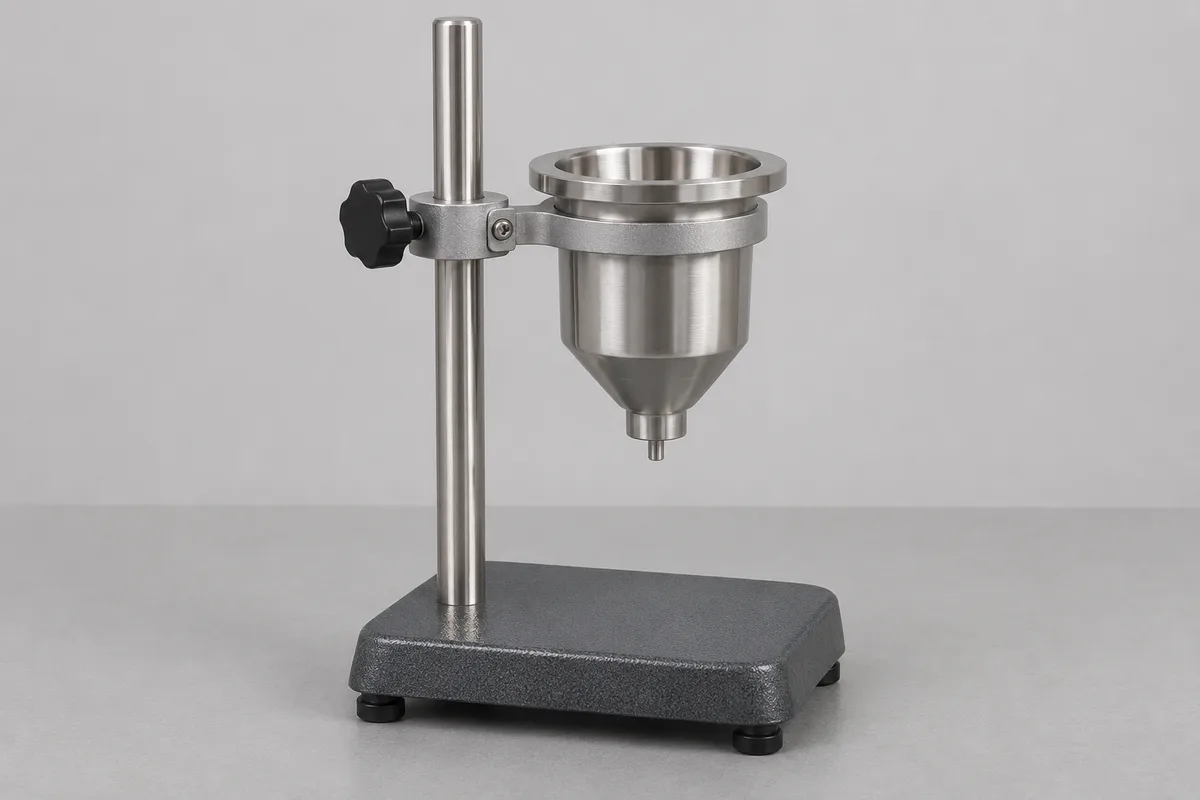
Efflux cup
Identify the cup pattern as well as the nominal orifice diameter. A time in seconds from one cup design is not automatically interchangeable with the same elapsed time from another.
Two cups sold under different cup systems may both be marked “4 mm”. The same coating need not take the same time to run through them. Record the cup system and the measured time at its working temperature before using an older batch limit.
- Range and configuration
- The primary result is an efflux time in seconds. Conversion to viscosity requires the equation and valid time range for that cup.
- Manufacturers and models
- Elcometer 2353/4 is an ISO flow cup with a 6 mm orifice and a published kinematic viscosity band of 188–684 cSt. Other orifices and cup standards have different conversion ranges.
- What we check
- Measure the drain time of a reference oil at the specified temperature. Compare it with the certified or assigned time for the cup type.
- Reference equipment and accuracy
- Use a certified viscosity oil, calibrated timer and thermometer. Worn orifices and temperature variation affect the comparison.
- When to repeat the check
- Inspect the orifice after cleaning. Repeat the oil check if a tool has touched the edge.
Technical references Elcometer 2351, 2352 and 2353 viscosity cups