
On this page
Which part of the station needs checking?
On a simple collecting gauge, the catch area and the reading on the measuring vessel go together. On a weighing gauge, it is the change in collected mass that produces a rainfall reading. For either design, identify the collector supplied with the instrument. A replacement funnel with a different opening changes the relationship between water collected and rainfall depth.
Bucket tips and logger totals
A tipping-bucket gauge can be checked with a known quantity of water delivered at a controlled rate. State the rainfall intensities of interest, particularly if you use the station to record short, heavy showers. The delivery rate, number of tips and logger reading give you a way to locate a discrepancy. For instance, a gauge set to 0.2 mm per tip should add 2 mm to the logger total for ten registered tips.
Working on an installed gauge
Identify the station and the dates of any bucket replacement or logger setting change. If the logger is staying in service during the test, agree how the test period will be marked so the added water is kept out of the rainfall record.
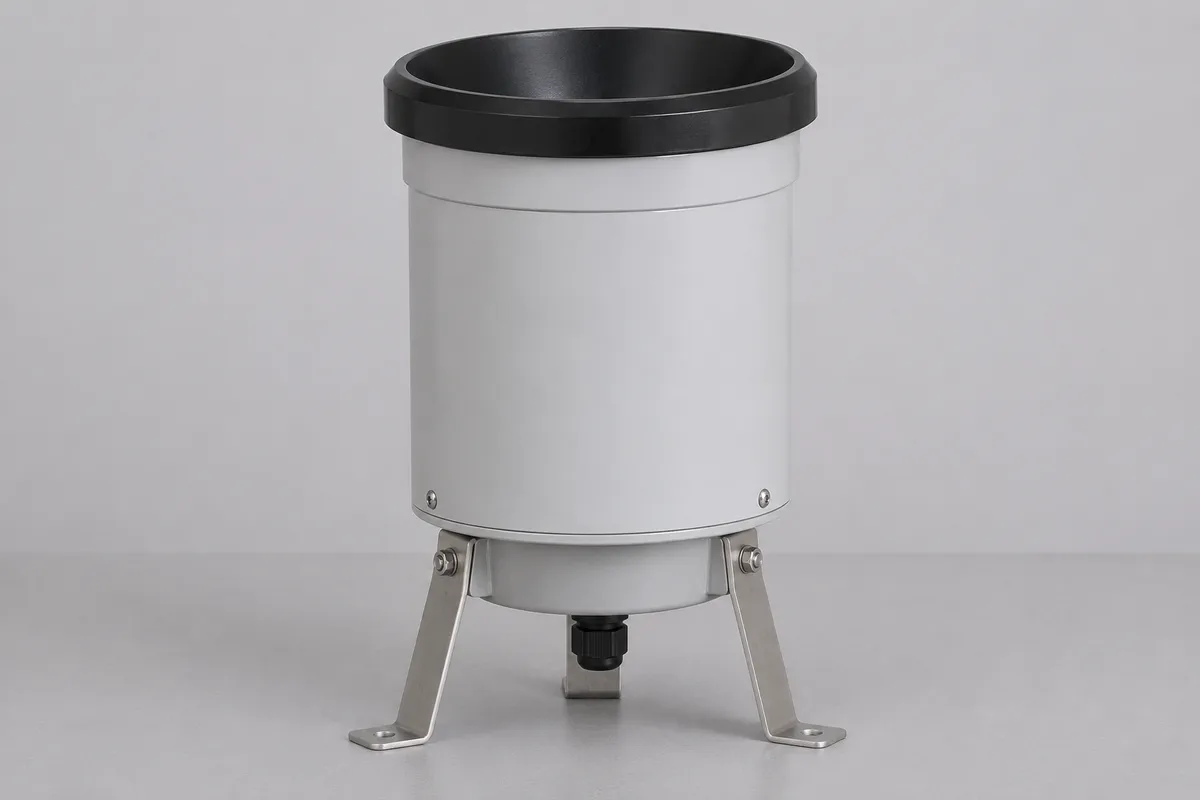
Rain gauge
For a tipping-bucket gauge, a count of bucket tips becomes rainfall depth using the factor assigned to that gauge. For a manual collector, depth comes from the collected volume and opening area. Tell us which design you use, its collector dimensions and, where relevant, the factor configured in the logger. A logger change can alter the reported rainfall even when the collector is untouched.
Twenty recorded tips represent 5.08 mm of rain on a standard TE525 at 0.254 mm per tip. On the TE525MM at 0.1 mm per tip, the same count represents 2.00 mm. Compare the logger multiplier with the fitted funnel and model if the raw pulse count looks right but the reported rain total does not.
- Range and configuration
- One tip represents a rainfall depth over the collector area. A logger with the wrong multiplier can produce consistent but incorrect totals.
- Manufacturers and models
- Campbell Scientific lists the Texas Electronics TE525 with a nominal 0.01 in, or 0.254 mm, per tip. The TE525MM has different scaling. Vaisala’s RG13 is another tipping-bucket model.
- What we check
- Compare the bucket count with a known water quantity under the manufacturer’s test conditions. Check that the logger records each pulse using the multiplier for the installed model.
- Reference equipment and accuracy
- Use a calibrated volume or mass reference, a verified collector area where required and an independent tip count. Keep both bucket results when checking balance.
- When to repeat the check
- Check levelling and collector condition routinely and repeat verification after bucket adjustment, relocation or a change to logger scaling.
Technical references Campbell Scientific TE525 series rainfall per tip · Vaisala product reference