
On this page
How the control room expresses pressure
What does the control room display: absolute pressure or pressure relative to the atmosphere? Send us the lower and upper range settings, the engineering units and the output the controller reads. This is worth checking when a replacement module takes over from a transmitter configured for gauge pressure.
Consider a linear transmitter set for 0 to 2 bar absolute and 4–20 mA. At 1 bar absolute, its expected output is 12 mA. Venting the port is a different check because room pressure on the day may be above or below 1 bar absolute.
Specifications and service checks
A transmitter replacing a vacuum gauge might feed a screen labelled simply “pressure”. Ask the control engineer whether the screen uses kPa absolute or kPa gauge, particularly at the alarm point. Identical numerical spans do not establish the same pressure reference.
- Range and configuration
- On an absolute transmitter, 0 bar absolute refers to vacuum. An instrument configured 0–2 bar absolute may read near 1 bar with its port open to the room.
- Manufacturers and models
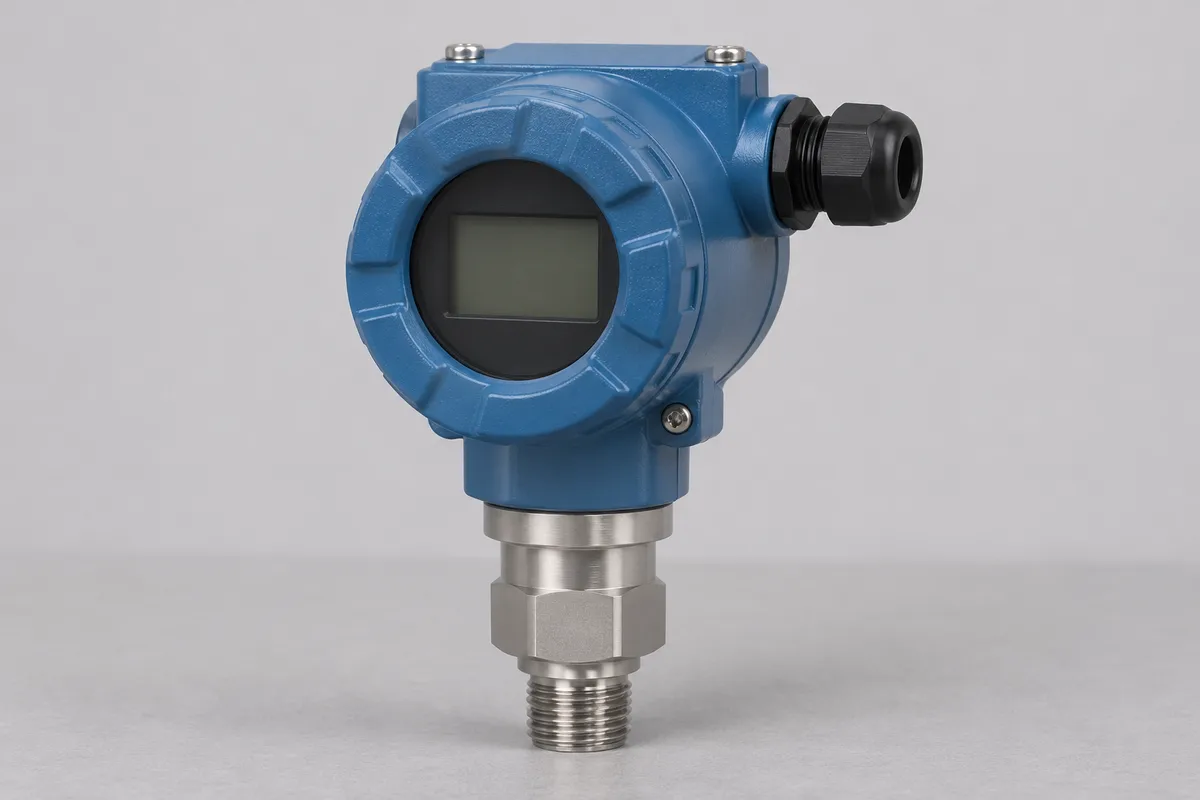
- Emerson's Rosemount 3051 family includes differential, gauge and absolute versions with several output options. Use the complete model code.
- What we check
- Compare known pressures with the analogue or digital process value actually used. Record the configured transfer characteristic and distinguish the as-found and adjusted results.
- Reference equipment and accuracy
- Use a calibrated pressure reference of the correct mode. A calibrated current meter is also needed for a loop-output check. Both uncertainties enter the result.
- When to repeat the check
- Review the interval against drift in the working range. Check again after a sensor change, rerange or repair when it affects the reported value.
Technical references Product Data Sheet: Rosemount 3051 Pressure Transmitter