
On this page
Cumulative and differential channel readings
Include the channels and sample volumes used in your inspection record. A reading labelled cumulative includes particles above the chosen threshold, while a differential channel represents a size band. Keep this setting with any printout submitted for comparison.
A raw count of 10 particles in a 10 L sample corresponds to 1,000 per m³ for that same size channel. A report may already have made that conversion. Include the original sample volume, the units on the export and the cumulative or differential setting before comparing the result with another counter.
Specifications and service checks
A facilities export has one column headed “≥0.5 µm” and another headed “0.5–1 µm”. Counts above a threshold and counts within a band answer different questions. Include the original channel headings and sample-volume setting so the same display convention can be used in the instrument review.
- Range and configuration
- The TSI AeroTrak 9306-V2 lists size channels spanning 0.3 to 10 µm. Particle diameter and number concentration are separate reported quantities. Other counter configurations use different channel limits.
- Manufacturers and models
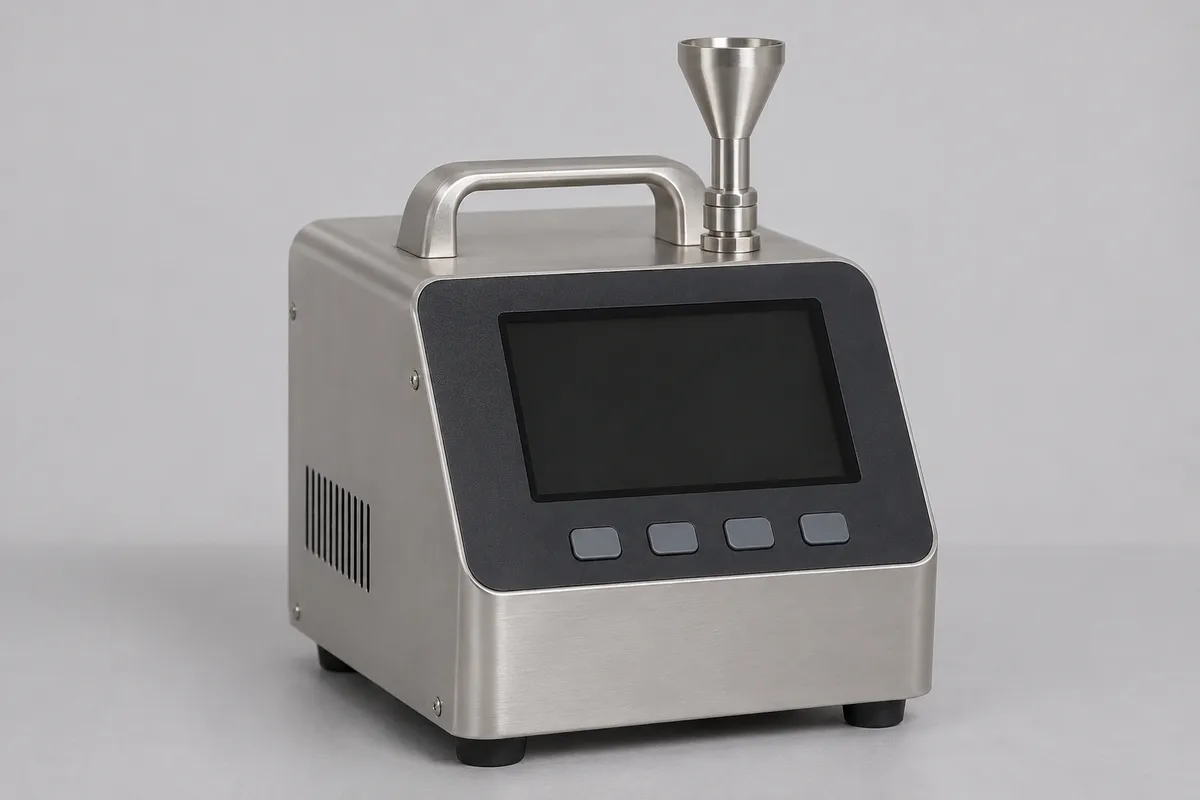
- TSI’s AeroTrak 9306-V2 is a handheld airborne particle counter. The model suffix identifies its channel configuration.
- What we check
- Identify the channel set, sampled-volume unit and counter serial number. A service report should identify the size indication and the volume measurement evaluated for that instrument.
- Reference equipment and accuracy
- Require traceability for the assigned particle-size reference and for the sample-volume measurement. State which channels the certificate covers.
- When to repeat the check
- Review the manufacturer’s service date together with optical and flow-service history. A changed optical head or pump merits review before routine use.
Technical references TSI AeroTrak 9306 model configurations