
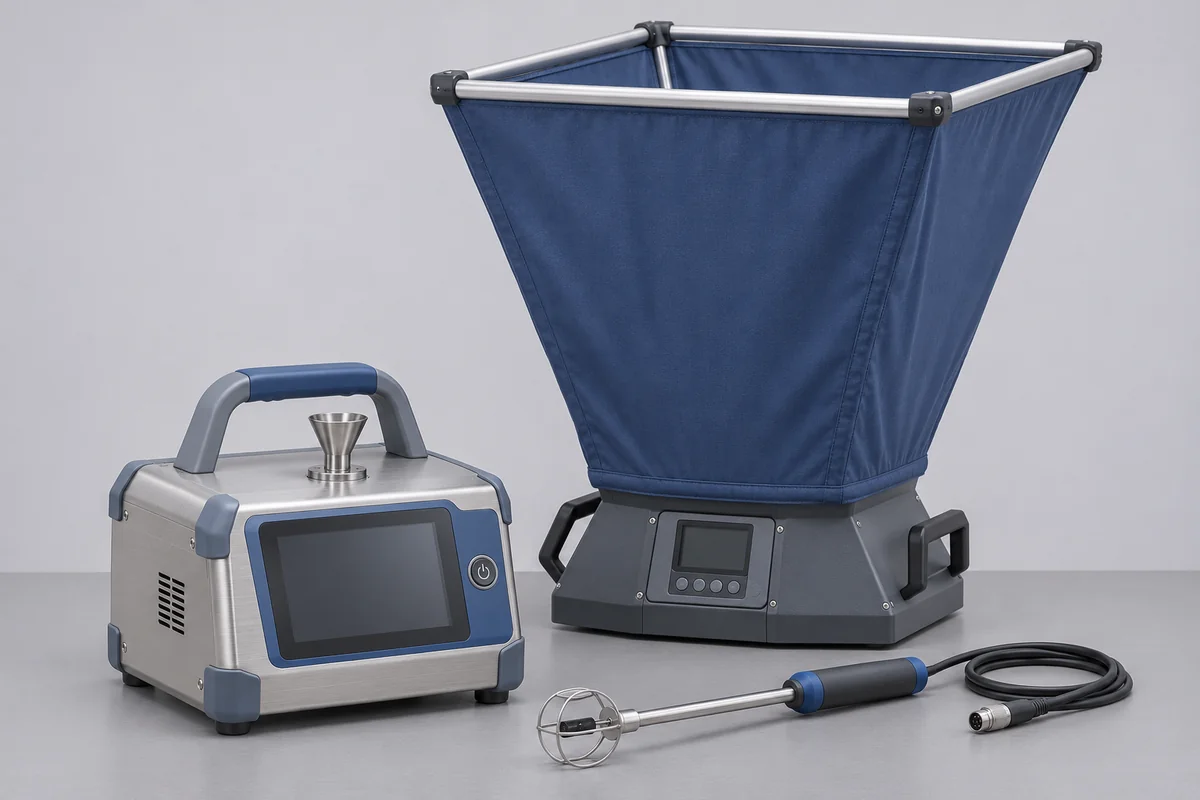
Aerosol photometers
An aerosol photometer needs its intended aerosol, response units, sampling arrangement and reference settings identified. Record whether it is used for filter leakage work or another concentration measurement. A photometer response is not the same quantity as a particle counter's number concentration. Send the manufacturer verification requirements to RTS so the aerosol reference, flow checks and accepted measurement functions can be reviewed before a quotation is agreed.
Particle counters and airborne particle counters
A particle counter used for cleanroom air, often listed as an airborne particle counter, needs its size channels, flow rate and sample-volume settings recorded. Identify the inlet, tubing and software configuration included in the enquiry. Counting performance and sampling flow are separate checks. RTS must review suitable particle references and the required method; a flow-only result does not establish the accuracy of the particle-size or count indications.
Smoke generators for airflow visualisation
A smoke generator is an aid for observing airflow, rather than a particle-count or air-velocity meter. Identify the aerosol material, output arrangement and the enclosure procedure for which it is intended. Ask for any required output or suitability checks as named tasks. RTS can review how it fits the proposed study, but a visualisation device should not be offered a generic calibration certificate without a defined measured quantity.
Retain the sampling configuration
Record the inlet, tubing, flow settings and the location of any accessories that belong to the instrument. A sample drawn through a different arrangement may answer a different question from the one described in an earlier report. Include the channel settings and software export format used by your team, especially when a monitoring system automatically combines readings from several instruments into one record.
Separate instrument evidence from room classification
A calibration or verification result belongs to the identified instrument and method. A room or filter assessment also needs a sampling plan, operating state, locations and its own acceptance criteria. Ask the quotation to keep those tasks separate. RTS must review specialist references and service capability before accepting particle or aerosol work; a general calibration listing should not be read as confirmation of every cleanroom test.
State how the equipment is used between visits
Tell us whether the unit is a portable survey instrument, a fixed monitoring head or a reference used to check other devices. Keep any recent settings change with the enquiry. For dispatch, agree the accessories and contamination information required by the receiving team. On return, reconcile instrument and channel identities before applying the report to a central monitoring record shared by several plant areas.
Ask for the individual results you need
Provide the required size channels, response points or flow checks in a written list. Keep uncertainty and conformity requirements with those items rather than applying one generic pass/fail instruction. The accepted task list should be clear before the instrument leaves its monitoring position.