
On this page
Reading the staff at known sight distances
When a crew reports two different height differences between the same points, the field book can tell us whether the sight lengths were balanced on both runs. Send the staff readings, sight distances and instrument position, along with the level’s model. If the reading changed after transport, mention the incident and whether the issue appears as the instrument settles on the tripod.
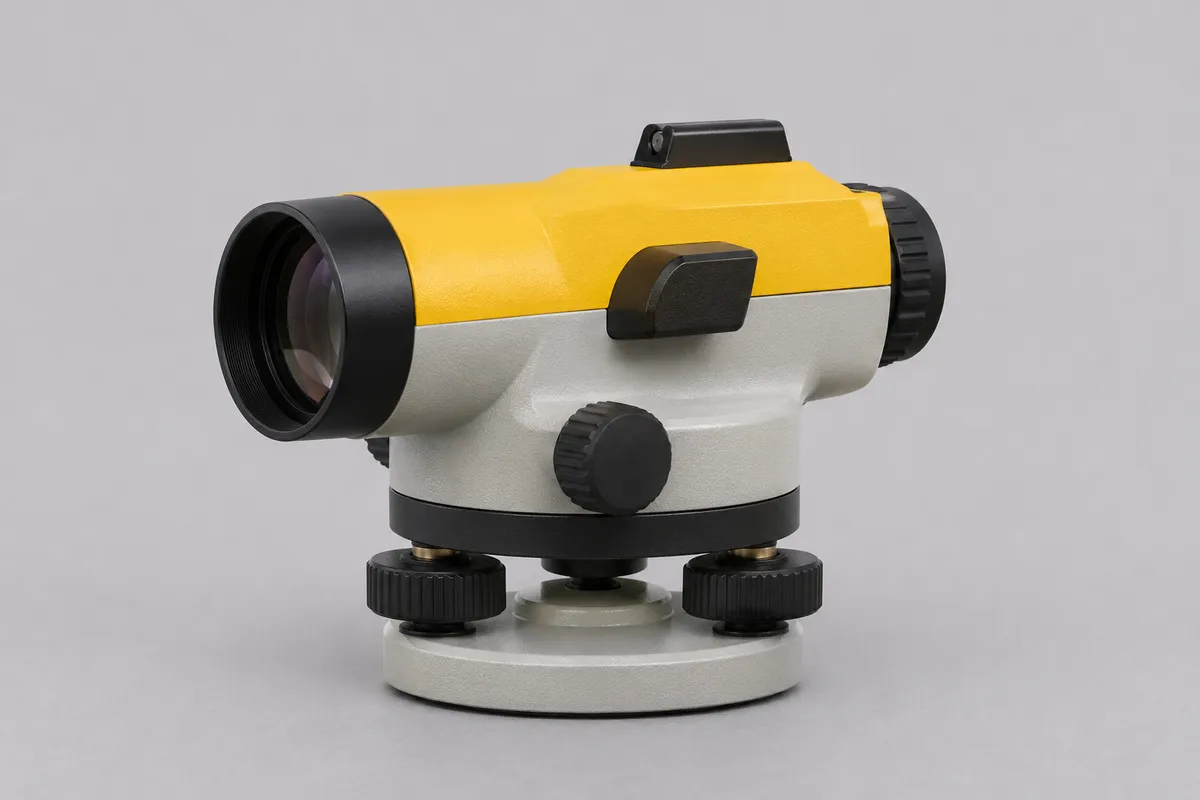
Auto level and staff
Identify the line-of-sight or levelling requirement and the procedure used by the survey team. Record the compensator type where known and include recent field-check observations. A check of the instrument and a measurement of the staff's graduations are separate items that need their own identification and reporting scope.
Specifications and service checks
A levelling run can return to its starting benchmark even when some line-of-sight error has cancelled between balanced sights. Supply the original staff readings and sight distances if the instrument is being assessed after a doubtful survey.
- Range and configuration
- The NA324 catalogue specifies 2.0 mm standard deviation per kilometre of double-run levelling. This is a surveying performance specification, not a maximum sight distance.
- Manufacturers and models
- Leica NA320, NA324 and NA332 are examples of automatic optical levels. The GFE 32 is another optical level, from geo-FENNEL.
- What we check
- Assess line-of-sight error and compensator behaviour with a calibrated arrangement or a documented field comparison. Identify the staff as a separate item.
- Reference equipment and accuracy
- A verified level collimator or suitable reference baseline and checked staff are used. Reference stability matters as much as telescope magnification.
- When to repeat the check
- Check after transport or impact and before a demanding survey. Increase the interval only when repeated results support the change.
Technical references Leica Geosystems product reference · geo-FENNEL product reference