
On this page
Which charging stage needs checking?
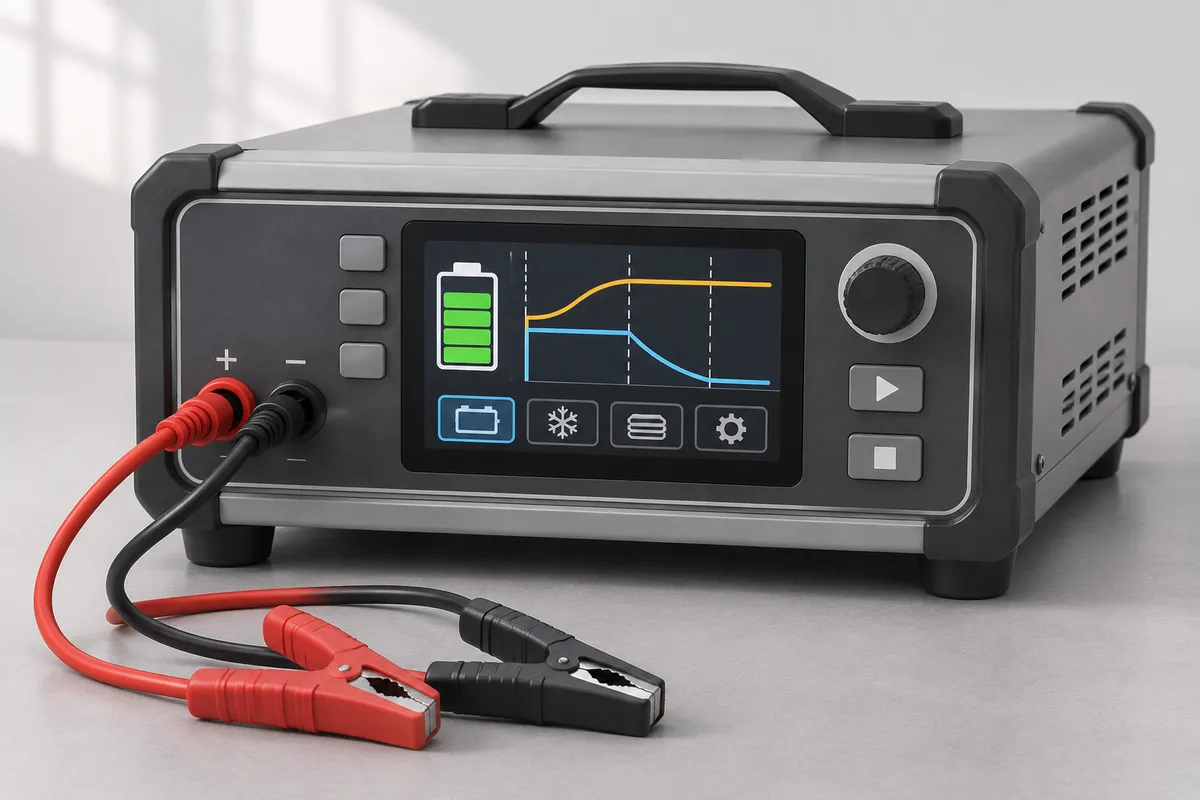
A maintenance sheet with just “24 V charger” leaves the important point open. An electrician may want the current while the charger is regulating current, the voltage later in the cycle, or the point where the charger changes mode. Send the charger model, battery type and selected profile. Mark any limits on a copy of the charge curve and say whether your team reads the front panel or measures at the output.
Battery chargers with measurement indications
Record the model, selected battery profile and the quantities for which you need results. State whether the output is checked under a specified load or with a particular battery arrangement. Keep charging behaviour and electrical indication accuracy as separate requirements. RTS measures the charger indications and output under the selected charging stage and load condition.
Specifications and service checks
If the operator reads “full” on the charger at the end of a shift, identify whether the criterion is terminal voltage, a current threshold or an internal program state. A voltage and current comparison can then be distinguished from a test of the charger’s cycle logic.
- Range and configuration
- Identify the nominal battery voltage, charge stages and rated current. A changing output during a charging cycle cannot be evaluated as a fixed DC setting.
- Manufacturers and models
- CTEK MXS 5.0 is a 12 V charger built for a nominal 5 A charging current. Charger type and battery profile determine what can be assessed.
- What we check
- Check the output or stage transitions specified for the charger with an appropriate representative load. Identify the stage at which readings were taken.
- Reference equipment and accuracy
- Use a calibrated voltmeter and current measurement with a compatible battery simulator or load. Timing references may be needed for timed stages.
- When to repeat the check
- Check after a control-board repair or a change in charging behaviour. The service history helps determine the recurring interval.
Technical references MXS 5.0 EU