
On this page
Integration time and resistance connections
List the functions used, any four-wire resistance terminals, and the integration or filtering setting from the bench procedure. If scanner channels are involved, identify the channel path separately from a measurement made directly at the front terminals.
For a four-wire resistance check on a fixture, identify whether the reference is connected at the front sockets or through the fixture switch. A difference appearing only through the switch can then be investigated without assuming the meter’s resistance range has drifted.
Specifications and service checks
For a resistance comparison where the last digits wander, record the integration setting as well as the selected range. A fast production reading and a slower averaged bench reading taken on the same meter can show quite different scatter while their mean values agree.
- Range and configuration
- The 8845A supports up to 750 V AC and the 8846A up to 1,000 V AC. Both have a 1,000 V DC range. The number of displayed digits is not an accuracy class.
- Manufacturers and models
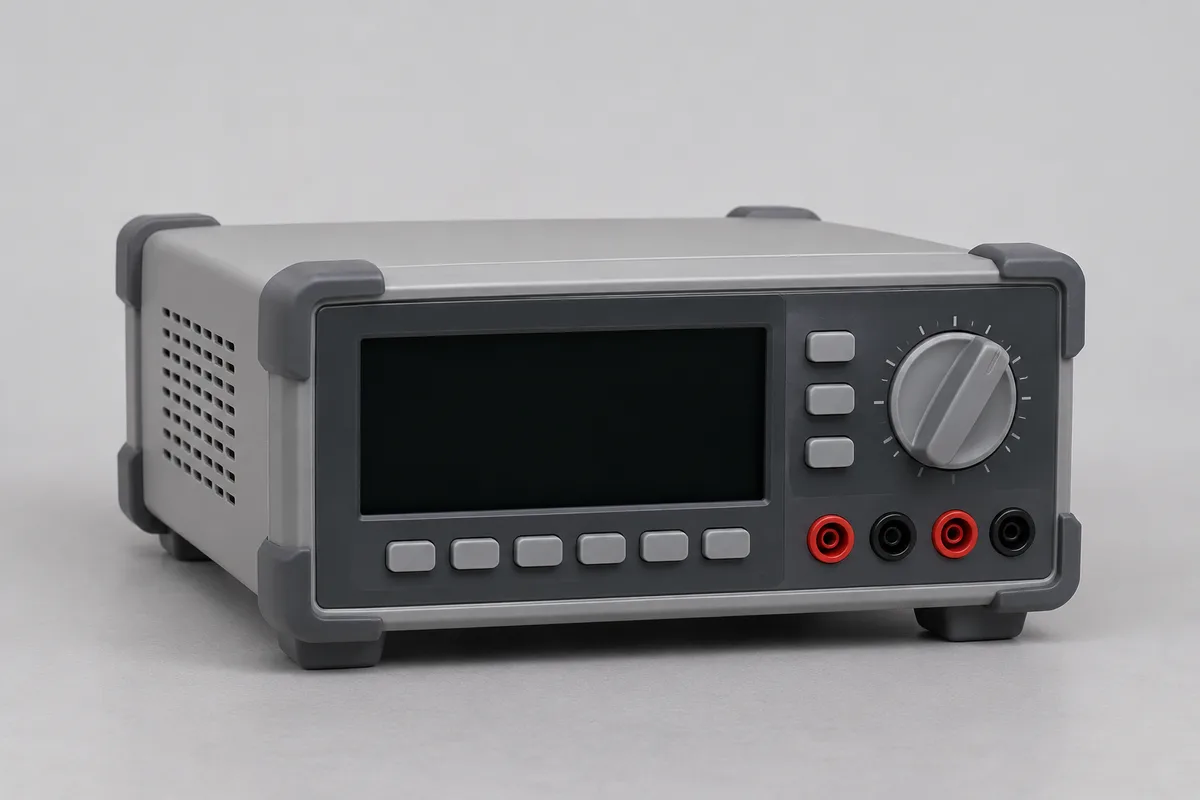
- Fluke 8845A and 8846A are 6½-digit bench meters. Their AC voltage limits differ despite similar front panels.
- What we check
- Compare stable input values on the requested terminals and functions. Identify whether a resistance result is for a two-wire or four-wire connection.
- Reference equipment and accuracy
- Use a calibrated multifunction source or electrical reference standards appropriate to each range. Include source stability and low-level thermal effects in the uncertainty.
- When to repeat the check
- Bench references often have intermediate checks at a stable voltage and resistance. Trend those readings alongside the manufacturer's accuracy period.
Technical references Fluke 8845A/8846A 6.5 Digit Precision Multimeter