
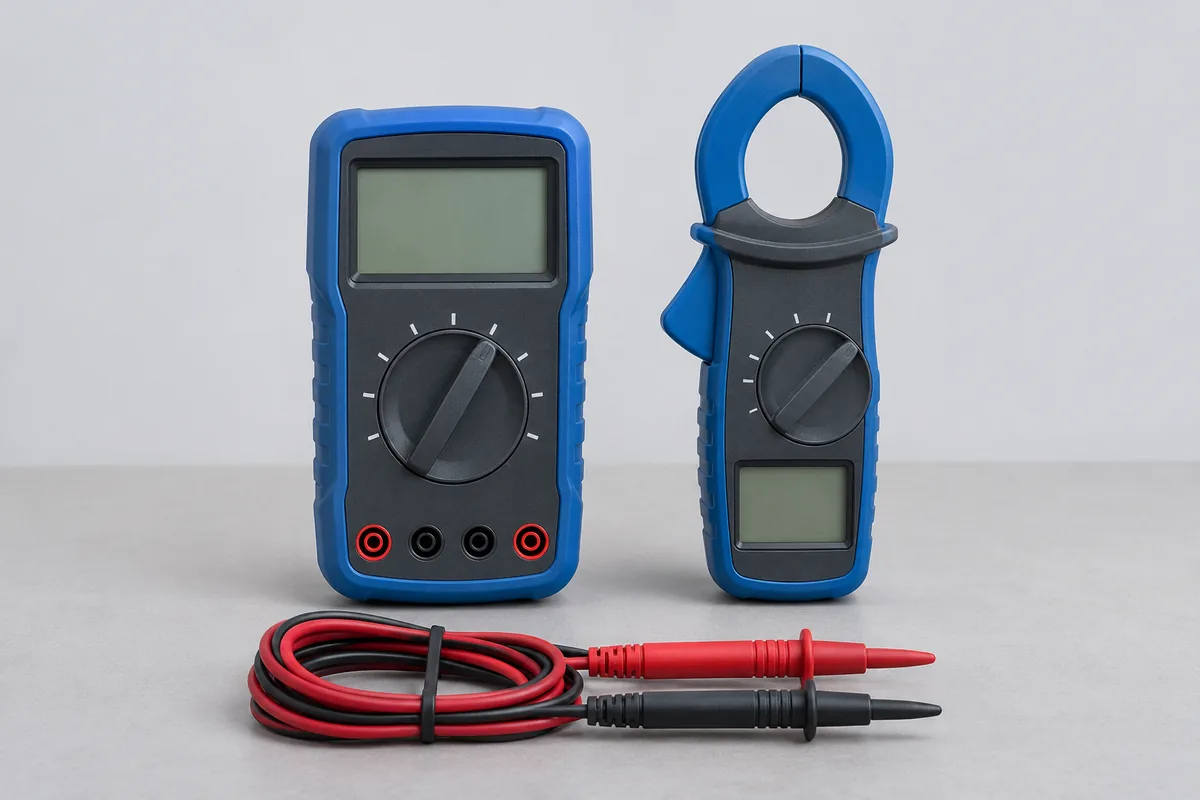
List the functions separately
Give voltage, current and resistance their own entries as needed. Specify AC or DC and the working range for each. For AC work, include the frequencies your procedure calls for. Add capacitance, frequency or temperature only if you use those functions and want them reviewed.
Record how the meter is connected
Identify external shunts, four-wire leads, temperature probes or other accessories that affect the reading you rely on. Give any separate accessory identification and ask which items should travel with the meter.
A reading at the bottom of a range
A test sheet may need a check at 20 mV DC even though stores lists the instrument as a 1,000 V meter. Include the point, polarity and selected meter range. For an AC point, include the frequency as well. The same displayed voltage can be used at mains frequency on one bench and at an audio frequency on another.
If an instrument has been exchanged between benches, compare the last certificate with the current procedure. Mark any new point and any one that can be dropped. This gives purchasing a clear basis for comparing quotations.
Analog multimeters with pointer scales
Include an analog multimeter on the instrument list under its own model and serial number. Photograph the scale and selector markings so the requested reading can be tied to the chosen range. Give the voltage, current or resistance function, full-scale value and points your technician reads. For a marked accuracy class or acceptance limit, include the manual reference rather than converting it to a percentage of the indicated reading without checking its definition.
Record any sticking pointer, damaged scale window or zero-setting problem before dispatch. State the normal operating position if the instrument specifies one. A resistance scale uses its own graduations and multiplier, so keep those with the requested resistance values. RTS can review the electrical source points against CC-4643 and agree which functions are included. A result for one range or a satisfactory zero indication does not establish all the other ranges. List any accessories that change the input separately, and identify whether the meter belongs to a maintenance kit or a fixed inspection bench.
Repeat calibration of a bench or field meter
If an earlier certificate lists the points you still use, refer to that certificate and flag any changes. Where different departments use different ranges on the same meter, include both sets in one request.
When the asset register only says electrical meter
If the register calls the item an electrical meter, send a front-panel photograph before choosing a service category. A single-function panel instrument, handheld multimeter and energy meter need different work. Record what the display indicates, its units, the selected range and how the input is connected. RTS can route the enquiry to the relevant function and keep one destination for the instrument instead of treating the generic description as another model.
Electrometer low-current and charge functions
An electrometer can measure quantities and levels beyond the functions used on an ordinary bench multimeter. State the current, charge, voltage or resistance function, connection and required points. Include the guarding or shielding arrangement specified by its manual. RTS must review the reference method and achievable scope; general multimeter entries do not establish coverage of every low-current or charge measurement.