
On this page
Conditions during a hold or a transition
Suppose the programme steps from a cool, dry condition to a warm, humid one. Your procedure might accept parts after a hold at the second condition, or it might also put a limit on the time taken to get there. Send that part of the programme and mark the shelf the parts occupy. We can report the temperature and humidity there during the hold and, where required, the transition time.
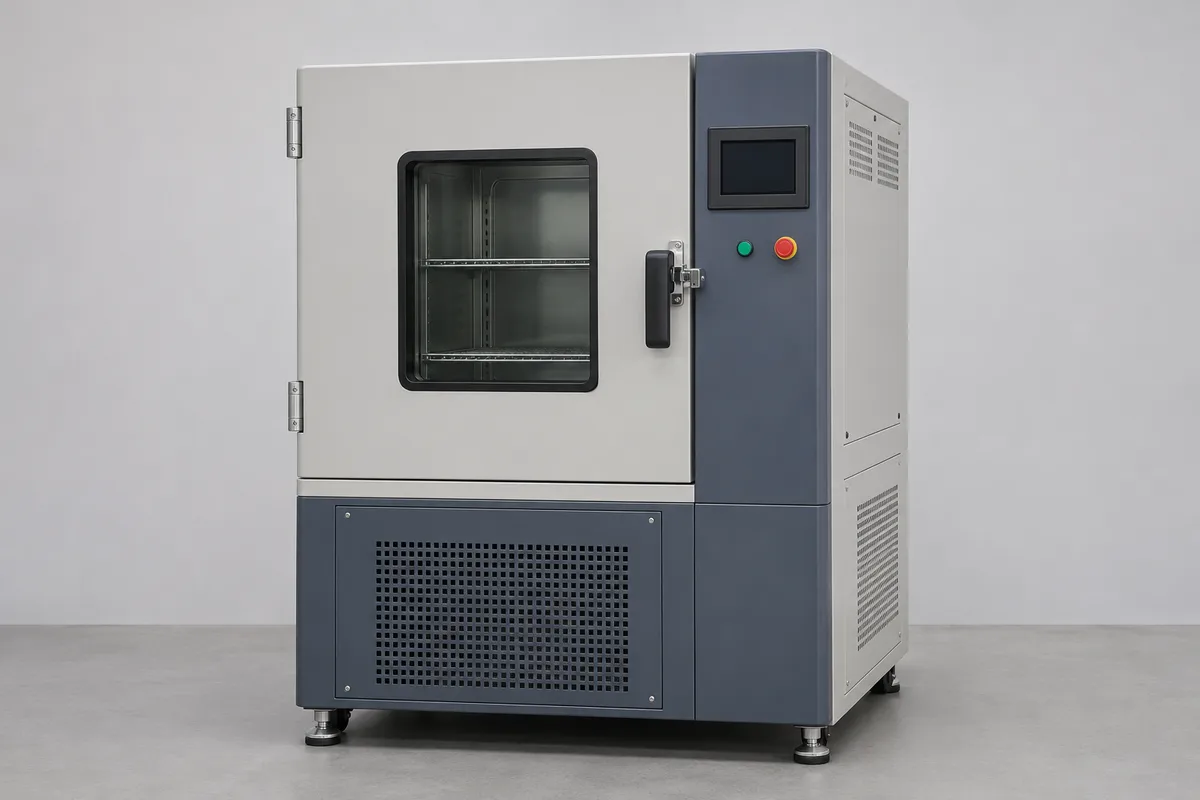
Climate chamber
A ‘climate chamber’ may be booked for a single hold or for a cycle that moves between several temperature and humidity settings. If a part is accepted at the end of a particular hold, mark that interval and the occupied shelf on the programme. That tells us where the temperature and humidity results are needed.
A segment of a test programme calls for humidity during a temperature hold. Identify the simultaneous temperature and humidity pair and how long the hold lasts. Separate high-temperature and high-humidity checks alone would leave that combination unexamined.
- What we check
- Compare the display with independent measurements across an agreed working volume. Record which shelves were occupied and separate variation over time from differences between positions.
Shared with Climatic chamber — Range and configuration · Manufacturers and models · Reference equipment and accuracy · When to repeat the check · Technical references
Specifications and service checks
If the cabinet is booked for a ramp followed by a hold, the clock can start at the programmed change or when the working area reaches the condition. Mark which event starts the hold in your procedure. It changes how the chamber trace should be read.
- Range and configuration
- BINDER quotes 10–80% RH for the KBF LQC 240. Check the operating diagram for the particular combination of temperature and humidity needed in your workspace.
- Manufacturers and models
- BINDER’s KBF LQC 240 is one example of a constant-climate chamber. Its specified envelope belongs to that model.
- What we check
- Mark each location in the occupied test volume and compare each reference reading with the controller indication. Keep the location-to-location spread separate from temporal stability at one location.
- Reference equipment and accuracy
- Use calibrated temperature and humidity probes with corrections valid at the requested conditions. The uncertainty must allow for spatial variation and sensor response.
- When to repeat the check
- Review after relocation, a sensor change or work on the humidifier. A check near the routine storage condition can reveal drift between mappings.
Technical references BINDER KBF LQC 240 data sheet · EURAMET climatic chamber calibration guide