
On this page
Contact load and rubbing motion
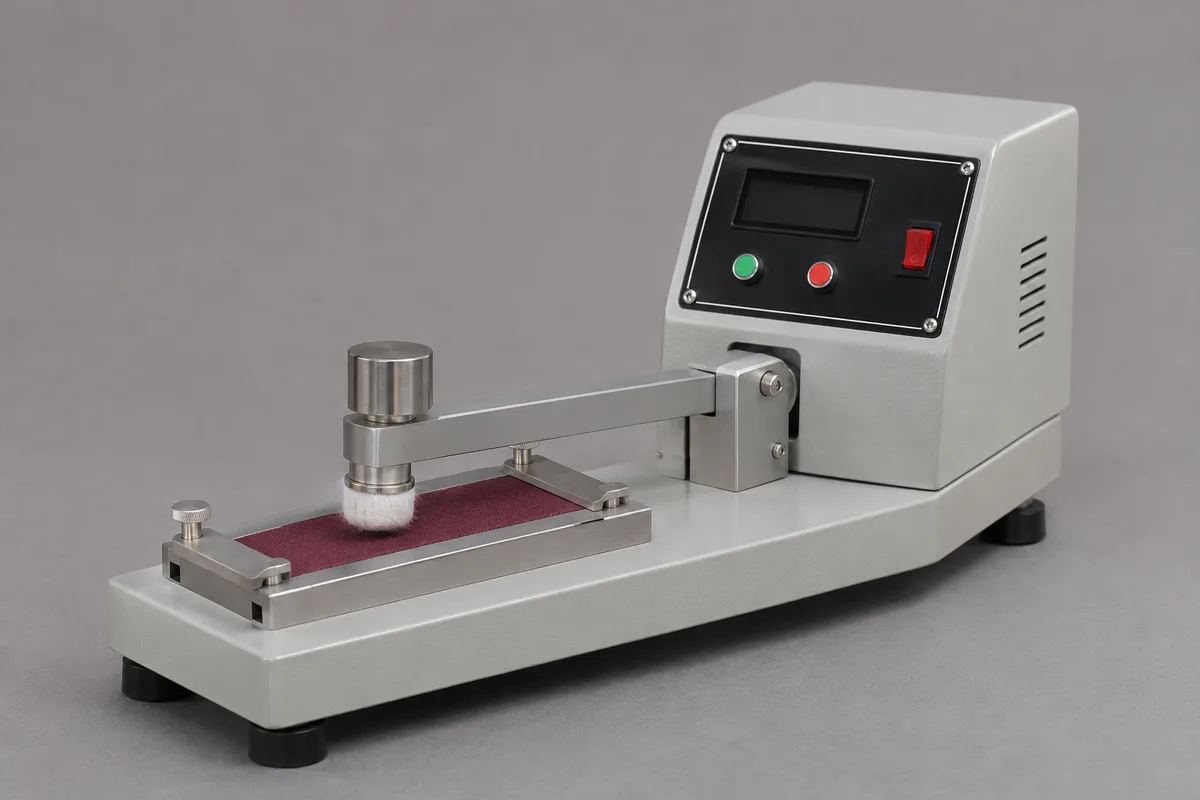
A counter reading of ten tells us how many cycles the machine registered. It leaves open the travel in each cycle and the load on the rubbing finger. For the linear model, quote the stroke and contact load in your method. For a rotary model, identify its movement and angular travel. A subsequent staining grade belongs to the fabric test result, separate from these machine checks.
Crockmeter movement and loading
State whether movement count, dimensions or applied loading needs a recorded result. Include the model and accessories used for wet or dry tests. Assessing those apparatus quantities is different from assigning a colour-fastness grade to the textile rubbed by the instrument.
Specifications and service checks
A rubbing head replaced between audits can change the contact geometry. Record the head fitted and the dimensions of its contact face alongside load and stroke so two runs describe the same station.
- Range and configuration
- The M238E has a 16 mm finger and a specified rotation of 1.125 turns in each direction. A reciprocating crockmeter is specified by its linear stroke length.
- Manufacturers and models
- The SDL Atlas M238E is a rotary crockmeter. James Heal also makes the Crockmaster for rubbing fastness testing.
- What we check
- Check finger force, travel and the indicated number of cycles. Measure angular travel on a rotary machine and linear stroke on a reciprocating one.
- Reference equipment and accuracy
- Use a checked angular or linear reference suited to the drive, a calibrated force gauge or balance for the finger load, and a dimensional reference for the finger diameter.
- When to repeat the check
- A replacement finger or worn drive changes the contact conditions. Check these between scheduled service visits.
Technical references SDL Atlas product reference · James Heal product reference