
On this page
Volume of the cup and its lid
Identify the cup material, nominal volume, lid and temperature at which the volume is needed. If a coating batch is assessed by mass divided by cup volume, keep the cup’s volume result separate from the calibration of the balance used for the weighing.
For a nominal 100 mL cup weighing 120 g more when filled than when empty, the nominal-volume calculation gives 1.20 g/mL. If the assigned cup volume differs from 100 mL, use that assigned volume at its stated temperature when interpreting the comparison.
Specifications and service checks
A paint supplier may state density in kg/L while a receiving laboratory records g/mL. The numerical values in these two units are the same. If they still disagree, compare sample temperature, filling and air bubbles before assigning the difference to the cup’s volume.
- Range and configuration
- Density is sample mass divided by cup volume. At 100 cm³, a 0.1 g weighing error alone contributes 0.001 g/cm³.
- Manufacturers and models
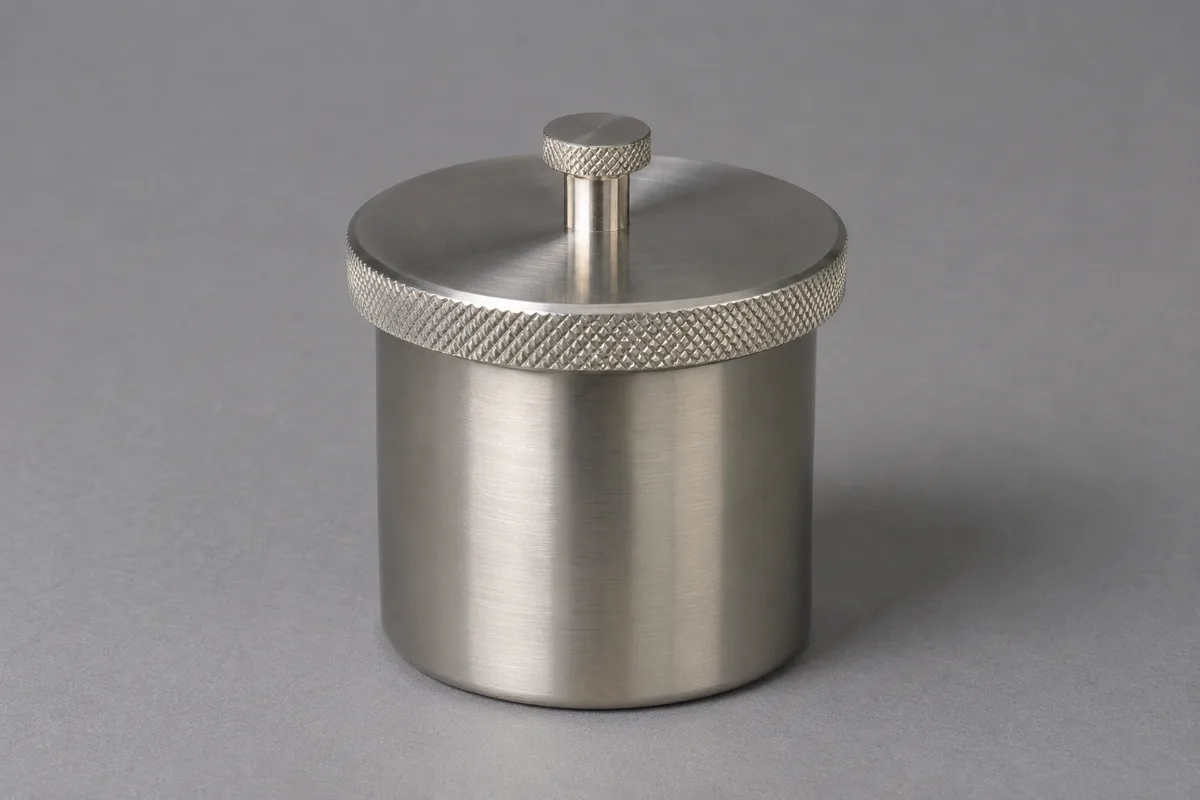
- Elcometer 1800 stainless-steel cups include 50 cm³ and 100 cm³ versions. The lid belongs with the cup whose volume is established.
- What we check
- Determine contained volume gravimetrically using water of known density at measured temperature. Report the cup and lid together.
- Reference equipment and accuracy
- Use a calibrated balance and thermometer with suitable resolution. Water density, filling repeatability and retained bubbles affect the result.
- When to repeat the check
- Check the rim and lid fit after a drop. Re-establish volume if the lid is replaced.
Technical references Elcometer 1800 Density Cup