
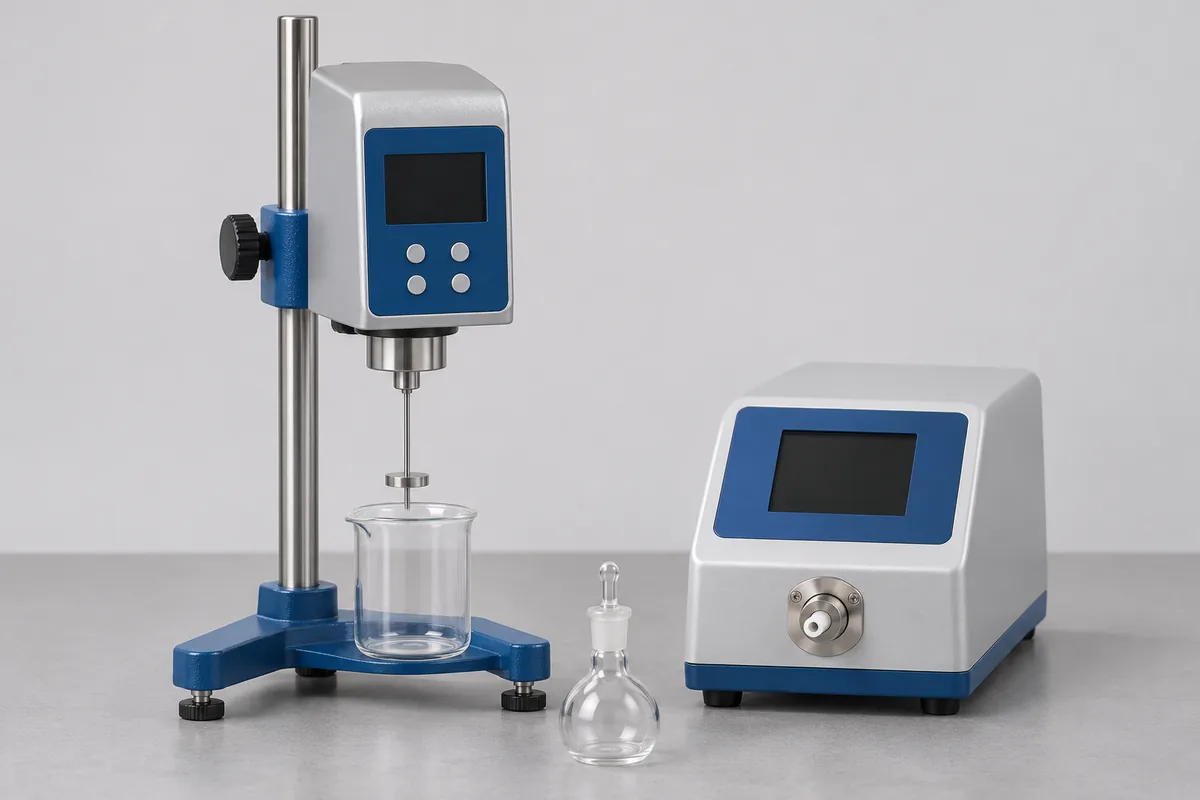
Describe the instrument and the reporting scale
For a digital meter, give the model, serial number, measuring-cell arrangement and operating temperatures. Identify whether the report uses density, relative density or a calculated concentration scale. A concentration derived from density depends on the relationship selected in the instrument, so include that configuration when it matters to your method.
For a density cup, pycnometer or specific-gravity bottle, record the nominal volume and identify its matching lid or stopper. Include any marked reference temperature and the previous certificate. Keep the components together; a different closure can change the defined filled volume.
State what the certificate must establish
A comparison of a digital density reading at a stated temperature differs from determining the volume of a vessel for later use with a balance. Specify which result is required and attach the method’s acceptance limits. For a repeated booking, send the earlier reference conditions so the requested work can be compared consistently.
List the reference liquids used for routine checks and their assigned values and temperatures. Report any unstable readings, suspected bubbles or residue already observed in the measuring cell. RTS will review the equipment, reference materials and suitable method before confirming the work.
Keep sample history with the enquiry
Describe the liquids previously measured and any cleaning or servicing already carried out. Ask which components should be sent and what preparation is required before arranging transport. Keep a glass bottle or cup protected with its own identified closure. For installed equipment, provide the access and release arrangements instead of assuming the sensor can be removed.
Alcoholmeters and the stated scale
An alcoholmeter uses a scale intended for a particular liquid relationship. Copy whether the scale expresses alcohol by volume, mass or another convention, together with its reference temperature. Give the marked points requiring evaluation and retain the intended liquid specification. RTS must review the appropriate hydrometer method and reporting units; a general density result should not be silently converted into an alcohol result with an unspecified scale.
Hydrometers and density hydrometers
A hydrometer or density hydrometer needs its scale units, reference temperature and reading convention recorded. Photograph the stem markings and identify the liquid family used in the application. Give the requested scale marks, especially where a process uses only a short part of the stem. RTS can review the comparison method and surface-condition requirements; the position of the liquid meniscus must remain consistent with the agreed reading convention.
Lactometers
A lactometer enquiry should retain the instrument's scale definition and reference temperature, rather than treating the number on its stem as an unspecified density unit. Send the marked range and the points used by your quality procedure. If a thermometer forms part of the instrument, list that requirement separately. RTS can review the applicable dimensional or liquid-reference method without implying that the instrument alone determines milk composition or quality.
Specific gravity balance and immersion accessories
Identify the balance and its density or specific-gravity attachment as a system, with the sinker, suspension or immersion vessel where used. A mass calibration addresses the weighing function; the calculated density also depends on the defined comparison and conditions. Supply the laboratory method and temperature requirement so RTS can review whether the enquiry concerns mass alone or the complete density calculation.