
On this page
Which face sets the angle?
Include the base or magnetic face normally placed against the work, the angular positions required and the direction of tilt. A result for one sensing axis should identify that axis, particularly on a two-axis instrument.
If a fitter zeros the gauge on a machine bed and then measures a fixture set twelve degrees above the bed, that is a relative reading. The instrument need not display twelve degrees when it is placed against the same fixture using its absolute reference.
Specifications and service checks
If a gauge reads degrees on one station and percent slope on another, a reading of 45° corresponds to 100% slope. Write down the display unit with the setting when moving it between a tilted jig and a machine bed.
- Range and configuration
- WYLER gives ±60° as the measuring range for Clinotronic PLUS. For a fixed angle block, quote the angle between its working faces instead.
- Manufacturers and models
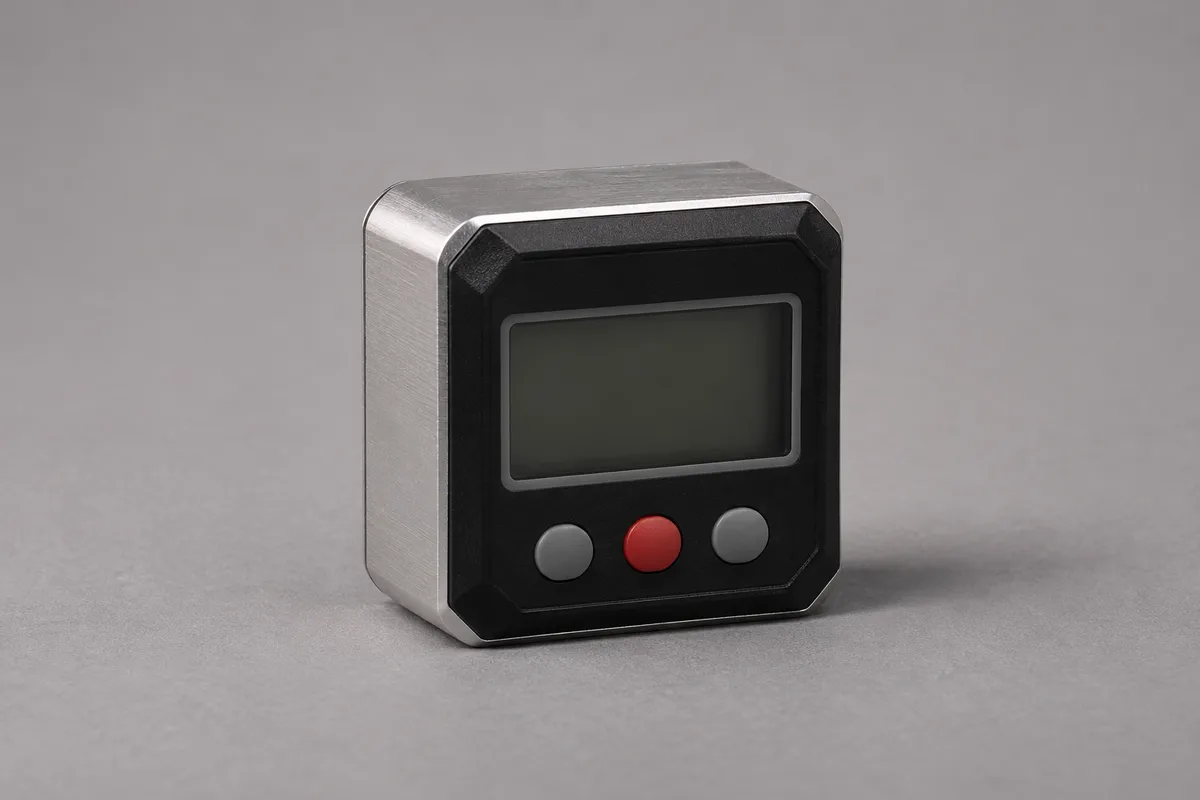
- WYLER Clinotronic PLUS is a portable electronic instrument. Its range and readout apply to this design.
- What we check
- Compare the indicated inclination in both directions with known reference angles. Use reversal to distinguish base zero from inclination where the design permits.
- Reference equipment and accuracy
- A calibrated angular table, sine setup or angle blocks establish the reference. Specify the base used, its orientation and the required uncertainty in degrees or arcminutes.
- When to repeat the check
- When the display permits relative zero, confirm which zero is active before a measurement. Recheck after a fall or loss of the stored reference.
Technical references WYLER Release 2.0 · WYLER Angle gauge reference