
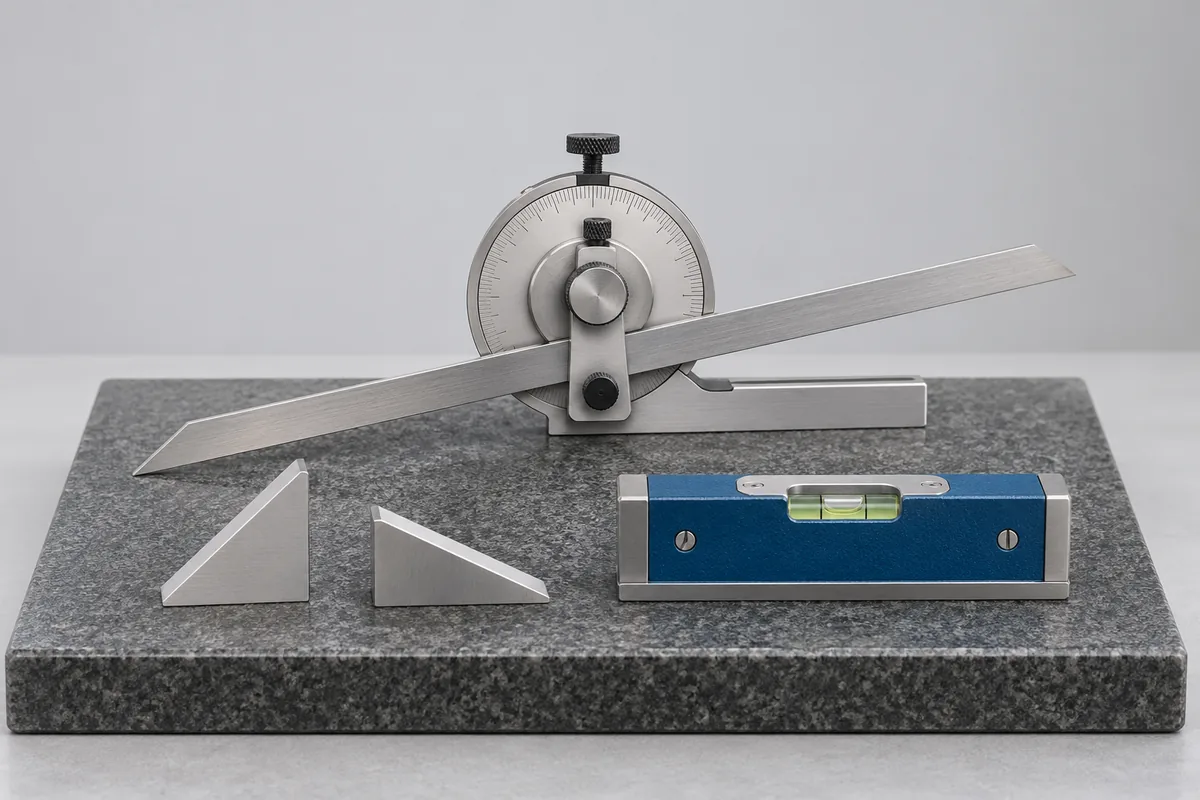
Identify the blade and its reference face
A universal bevel protractor can have a sliding blade and a detachable acute-angle attachment. Describe which pieces make contact with the part and list the attachments that will travel. Mention any movement at the blade clamp or a nick on the working edge. If the blade can be fitted in two positions, mark the one used for the inspection.
A digital angle gauge may display a relative angle from a user-set zero, or an inclination relative to gravity. Give the model and the mode selected in the work instruction. Ask RTS to confirm the reference setup and the angles covered for that instrument.
Degrees and minutes on the work instruction
One half of a degree is 30 minutes of arc. A drawing marked 30° 30′ therefore calls for 30.5° on a decimal display. Include the original notation, the tolerance from the drawing and the scale division on the tool. If you need a result with the blade reversed or with each working face against the reference, specify these positions on the same line.
Sending a toolroom set
A protractor with two blades should arrive with a way to identify each blade. At an IMT Bawal workshop, the tool crib can mark the case with the bench number and include a photograph of the pieces before release. If the job also uses feeler blades to check a gap, list those separately with their thickness markings.
Angle gauge block reference values
An angle gauge block is a reference artefact rather than a protractor with a moving indication. List each block's nominal angle, material, mark and measuring faces. State whether an individual angle, a face characteristic or an assessment of a combination is required. Keep the existing reference certificate with the enquiry. RTS will confirm the available method; a scope listing the block as a reference is not a calibration claim for the block.