
On this page
Dosing units and delivery intervals
Give the delivery intervals used during titrations and identify any replaceable dosing unit. Keep the initial counter reading and final indicated delivery with the reference value. That information makes a discrepancy at a small volume distinguishable from a cumulative error over a longer delivery.
Imagine that a titration normally starts after the counter has already advanced. A check of delivery from zero to the full nominal capacity does not directly examine the smaller interval used on that run. Specify the initial and final indicated volumes if the buyer needs that particular interval assessed.
Specifications and service checks
A digital burette used in successive dosing mode may display the last delivery or an accumulated total. For a 5 mL addition made three times, those screens could show 5 mL or 15 mL. Identify the display mode used for the laboratory’s own record.
- Range and configuration
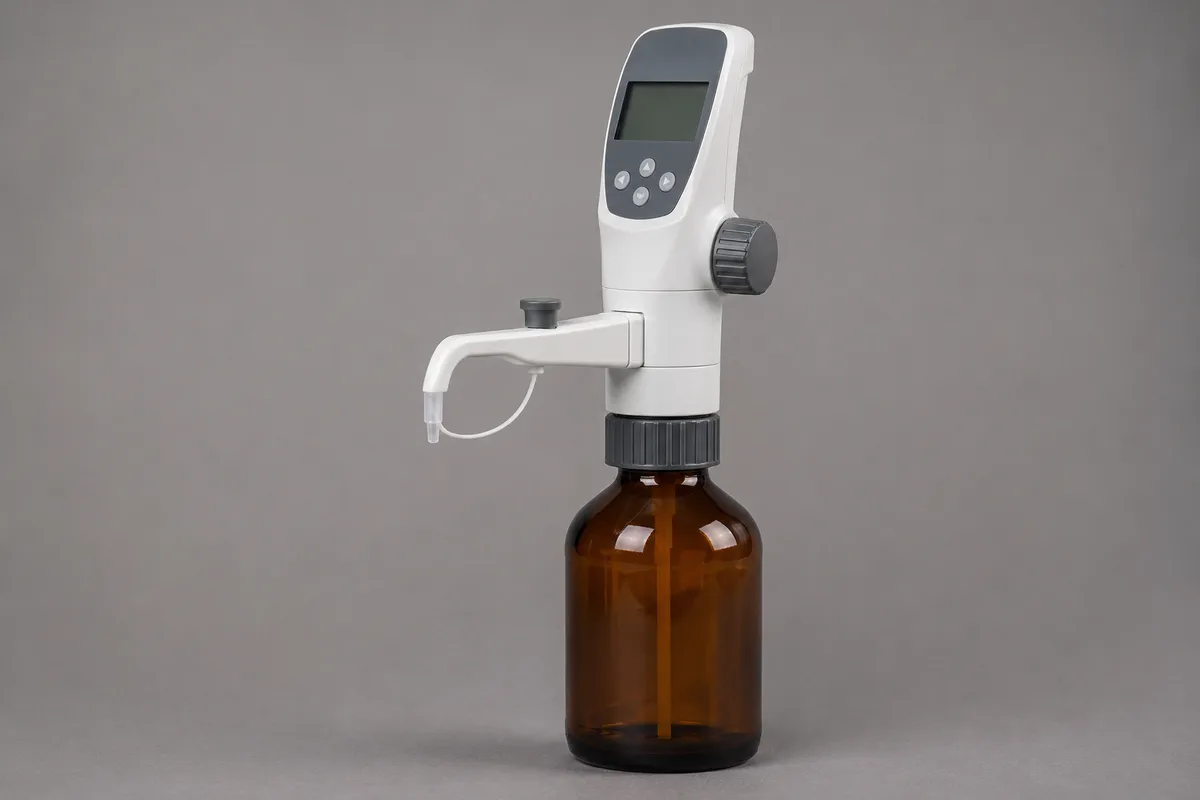
- BRAND supplies Titrette digital bottle-top burettes in 10, 25 and 50 mL versions. The display increment and the certified delivery tolerance are separate specifications.
- Manufacturers and models
- DWK DURAN and BRAND Titrette illustrate glass and piston-driven designs.
- What we check
- Compare delivered volumes across the working span. Read a glass burette by its meniscus and follow its drainage convention. For a piston burette use the appropriate piston-apparatus method.
- Reference equipment and accuracy
- Use a calibrated balance and a temperature reading for the gravimetric result. In a glass burette two scale readings can contribute to a partial-volume result.
- When to repeat the check
- Check for a leaking stopcock or valve between visits. Review delivery after replacing the tip or any part of the dosing assembly.
Technical references DWK DURAN 10 mL burette · BRAND Titrette manual · ISO 8655-6 gravimetric volume determination