
On this page
How far and how fast the carriage travels
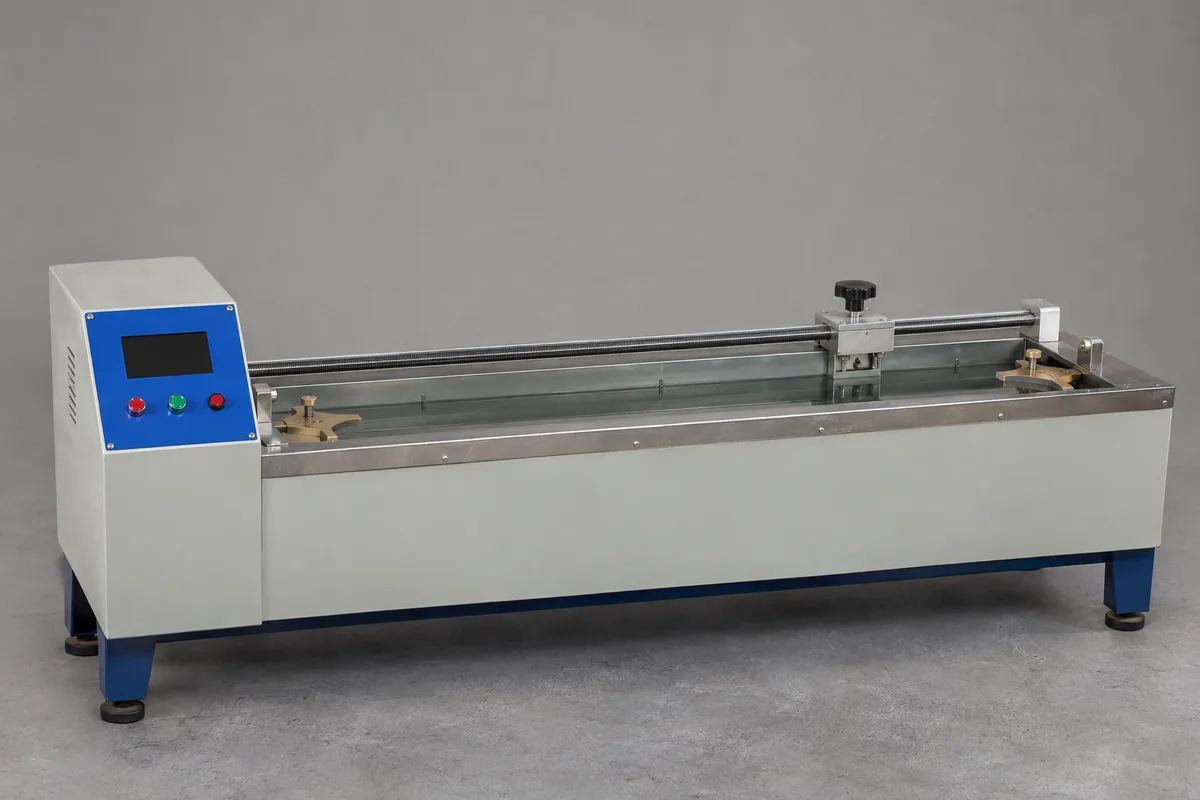
Suppose a carriage travels 100 mm in the observed interval. That distance can confirm its travel indication, but checking its rate also requires elapsed time. Give the normal speed setting, travel range and where your team reads the extension. If the bath temperature is included, mark the specimen positions used for it. On a multi-station frame, identify the station if a single mould sits out of line.
Ductility testing machine
State whether the system also records force. Ask for the required functions separately and supply the relevant acceptance limits. A travel check alone does not establish the thermal conditions, force channel or suitability of the complete material-test procedure.
Specifications and service checks
A travel reading in millimetres and a pulling rate in millimetres per minute are separate checks. A lab investigating a change in results can request carriage movement over a measured time as well as the length indication.
- Range and configuration
- The catalogue gives up to 1,500 mm stroke and a selectable speed of 1–400 mm/min on this model. Quote the actual working speed and bath temperature.
- Manufacturers and models
- Matest B055-20M is a ductilometer with force and displacement acquisition options. Humboldt also offers ductility testing machines for asphalt materials.
- What we check
- Compare carriage travel and elapsed time over a measured distance. Check bath temperature separately and include a force channel only where fitted.
- Reference equipment and accuracy
- Use a calibrated length reference and timer for rate, a traceable thermometer for the bath and an appropriately ranged force reference for load.
- When to repeat the check
- Recheck travel rate after belt or drive work. An independent bath reading between services can reveal thermostat drift.
Technical references Matest product reference · Humboldt product reference