
On this page
The temperature and humidity pairs you use
For a staged product test, distinguish the time allowed to reach a condition from the time the item must spend there. Give the configured programme and usable footprint so that the recorded histories can be matched back to the test specification.
A chamber that controls humidity as well as temperature may use only a limited set of paired conditions in routine work. List the pairs together, for example the humidity required at each temperature. Independent lists of temperatures and humidities may incorrectly suggest that every combination is required.
Specifications and service checks
Two runs at the same setpoint can give different results if one fills the upper shelves and the other leaves them clear. Mark the occupied volume on a shelf sketch and identify the fixed control probe. This locates the readings a customer needs for the intended working space.
- Range and configuration
- BINDER lists 0 to +70 °C for the KBF LQC 240 with lights off, and 10–80 %RH as its humidity range. Refer to the model’s climate diagram before combining any two extreme values.
- Manufacturers and models
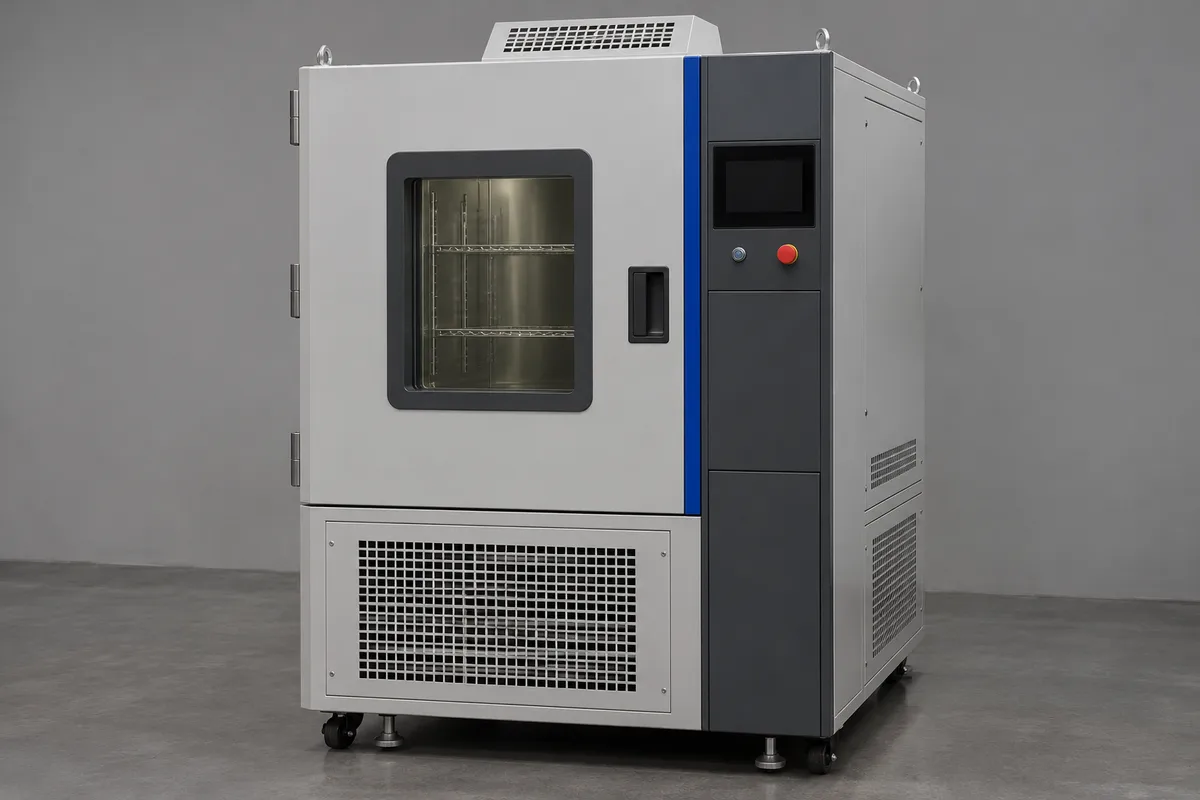
- BINDER’s KBF LQC 240 is one example of a constant-climate chamber. Its specified envelope belongs to that model.
- What we check
- Compare the display with independent measurements across an agreed working volume. Record which shelves were occupied and separate variation over time from differences between positions.
- Reference equipment and accuracy
- Use calibrated temperature and humidity probes with corrections valid at the requested conditions. The uncertainty must allow for spatial variation and sensor response.
- When to repeat the check
- Review after relocation, a sensor change or work on the humidifier. A check near the routine storage condition can reveal drift between mappings.
Technical references BINDER KBF LQC 240 data sheet · EURAMET climatic chamber calibration guide