
On this page
Loading fittings and force direction
List the force direction, working range and loading fittings. If the reference is used at several rotational positions, include that requirement. Give the indicator serial number and resolution so the interpolation values or errors can be interpreted with the same readout in subsequent work.
A reference set loaned to another factory can return with the transducer intact but connected to a different readout. Check the pair on the previous report before using the old force table or asking for a repeat at the same points.
Specifications and service checks
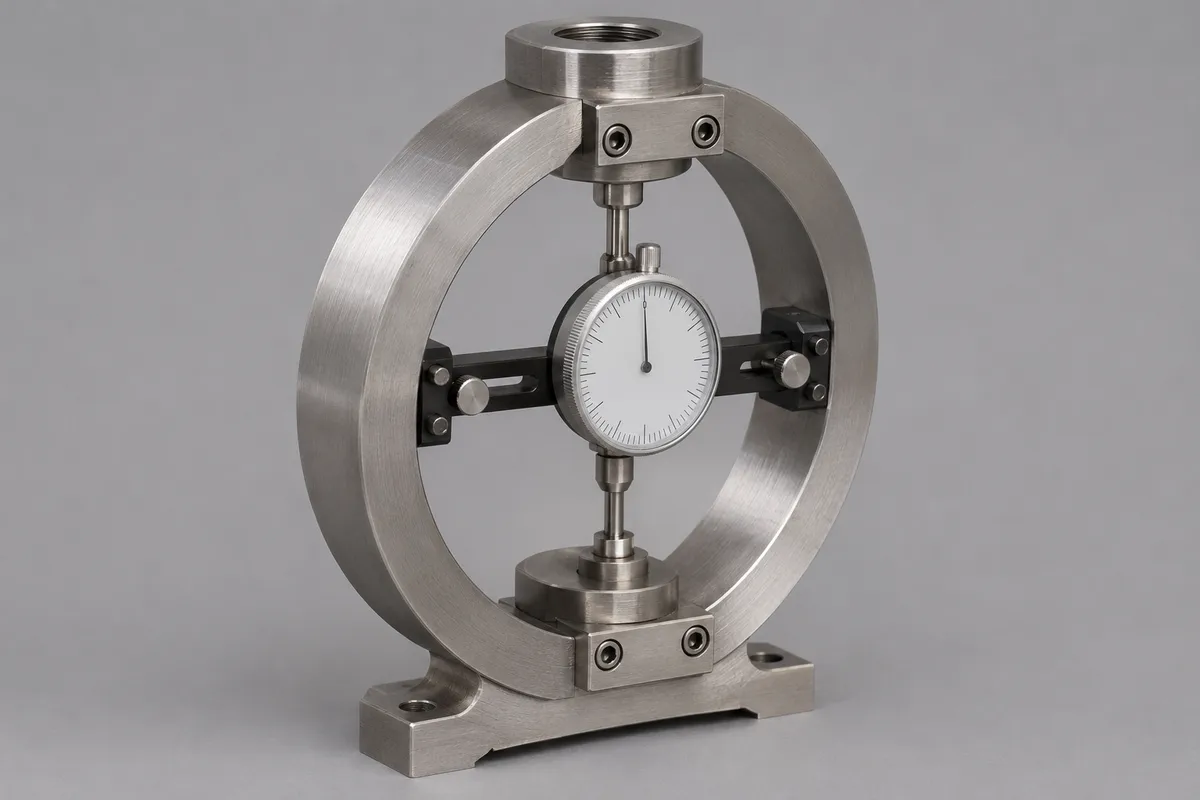
A ring with a dial in divisions needs its own force relationship. Two rings that each deflect 100 divisions under load can represent different forces. Keep the ring number, dial number and conversion information together when swapping rigs.
- Range and configuration
- A proving ring has a rated load and a defined loading direction. Its dial divisions or electronic counts are converted to force using the calibration of that particular ring and readout.
- Manufacturers and models
- Morehouse supplies standard proving rings. Record both ring and readout identifiers so the force relationship is tied to the correct pair.
- What we check
- Apply known forces in the specified orientation and loading sequence. Repeated readings, zero return, creep or reversibility can be needed for the intended force classification.
- Reference equipment and accuracy
- Use a calibrated force machine with suitable uncertainty at each load. When ISO 376 classification is required, identify the force range, loading direction and readout used for the classification.
- When to repeat the check
- A change to the readout, fittings or loading direction needs review. Look for residual deflection after unloading before using a proving ring as a master.
Technical references Standard Morehouse Proving Ring · ISO Force-proving instrument calibration