
On this page
Internal and external frequency references
Give the selected reference source, output frequencies and whether the bench needs frequency accuracy, output level or spectral characteristics. If the instrument has several independent outputs, identify the port and programmed setting beside each requested result.
A laboratory may lock several sources to a common 10 MHz reference for a bench comparison. Record whether the synthesizer used that reference. Removing the cable for field service returns the frequency performance to the source’s own reference configuration.
Specifications and service checks
A frequency sweep for a filter may depend on the exact start, stop and step values while a fixed-frequency source serves a different job. If a particular step is missing or slow to settle, identify that part of the programmed sweep.
- Range and configuration
- List carrier frequencies and output levels in dBm into the specified impedance, usually 50 Ω for this class. Frequency accuracy and output flatness need separate checks.
- Manufacturers and models
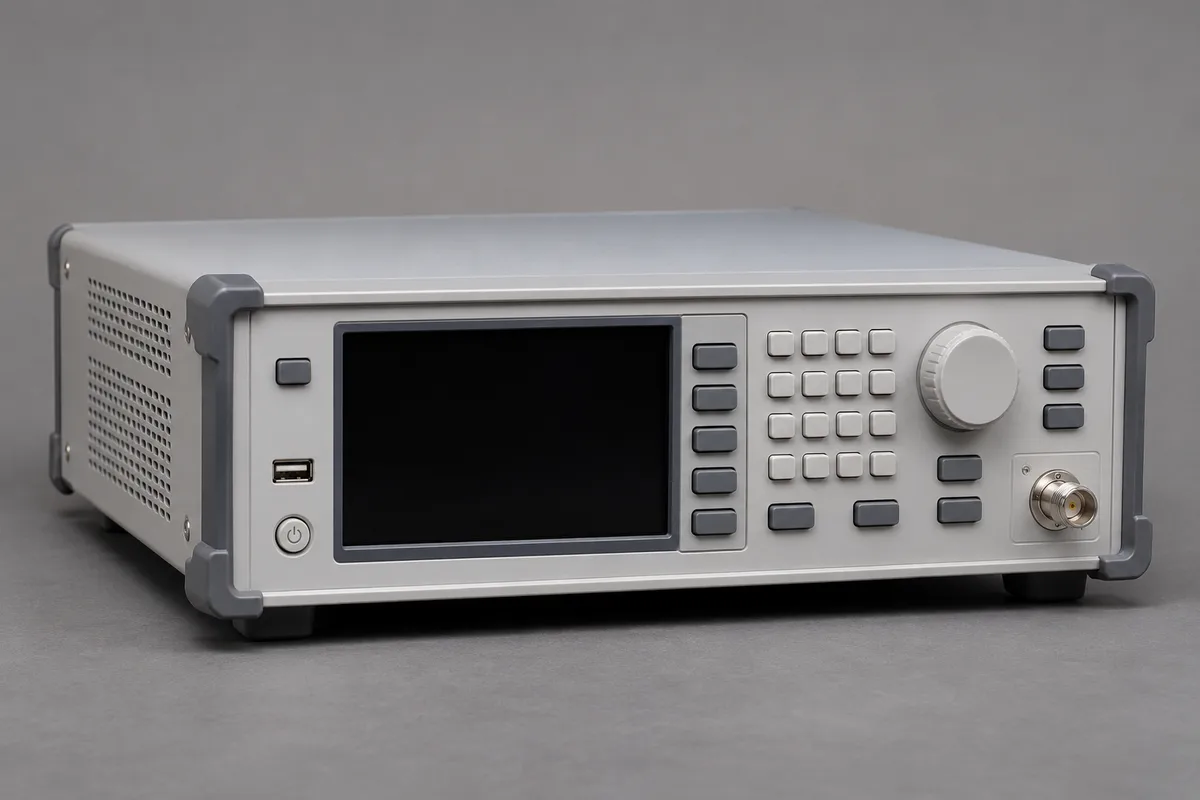
- Rohde & Schwarz SMB100B is an analogue RF and microwave source. The frequency limit and modulation features depend on the installed option.
- What we check
- Compare carrier frequency using an independent timebase. If tuning resolution or settling is specified, evaluate the selected frequency increments or switching event separately from absolute accuracy.
- Reference equipment and accuracy
- Use a counter with a calibrated timebase, calibrated power sensor and appropriate measuring receiver for modulation. Cable loss and mismatch belong in the power result.
- When to repeat the check
- Track changes at fixed reference frequencies and repeat output checks after connector or output-stage repair.
Technical references R&S®SMB100B RF and microwave signal generator