
On this page
Probe orientation and working air speeds
Record the probe model, direction marking and units used during the comparison. Where a telescopic probe is used inside a duct, include the speeds seen at the lowest and highest fan settings rather than ordering the display range by default.
A probe may spend most of its time checking low-speed air at a workbench and only occasionally go into a high-speed duct. In that case the estimate should include points in the bench range as well as the duct speeds. Tell us which readings matter at each location.
Specifications and service checks
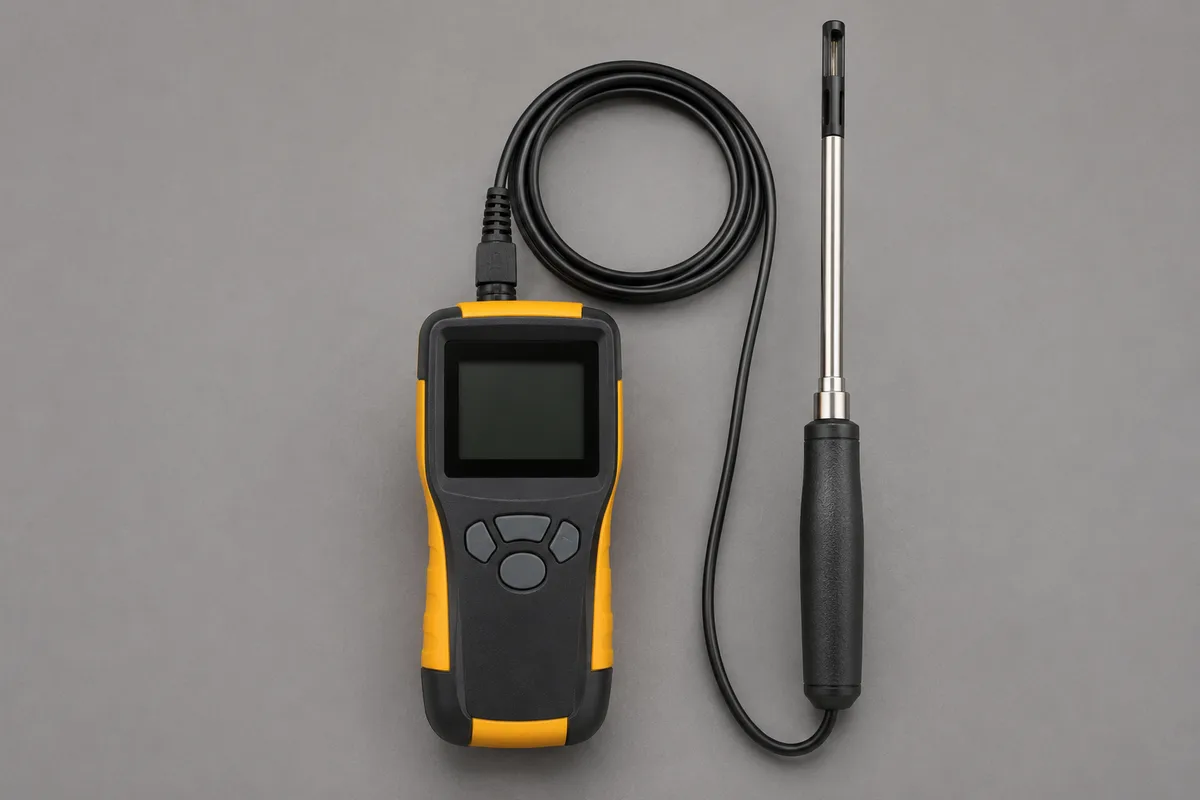
A small directional mark on a hot-wire probe can be hidden inside a duct opening. Note how the probe is normally oriented to the air stream and which extension or telescopic position is used. It gives the laboratory a reproducible arrangement for the low-speed points.
- Range and configuration
- Testo quotes 0–30 m/s for the 405i thermal probe. Give the lowest working speed and whether the instrument reports the speed directly or calculates volume flow from a duct area.
- Manufacturers and models
- Testo’s 405i is a hot-wire probe. In the same product comparison, its 410i uses a vane and has a different response.
- What we check
- Compare the probe with a reference air stream over its working speeds. Keep its directional mark and temperature compensation configuration in the test record.
- Reference equipment and accuracy
- Use a wind tunnel with a calibrated velocity reference at the sensing position. At low speed, zero behaviour and temperature sensitivity deserve an uncertainty allowance.
- When to repeat the check
- Oil films, dust and physical damage can alter a fine sensing element. Use the history of clean-air checks to decide whether a yearly visit is close enough.
Technical references Testo 405i and 410i metric specifications · NIST air speed metrology