
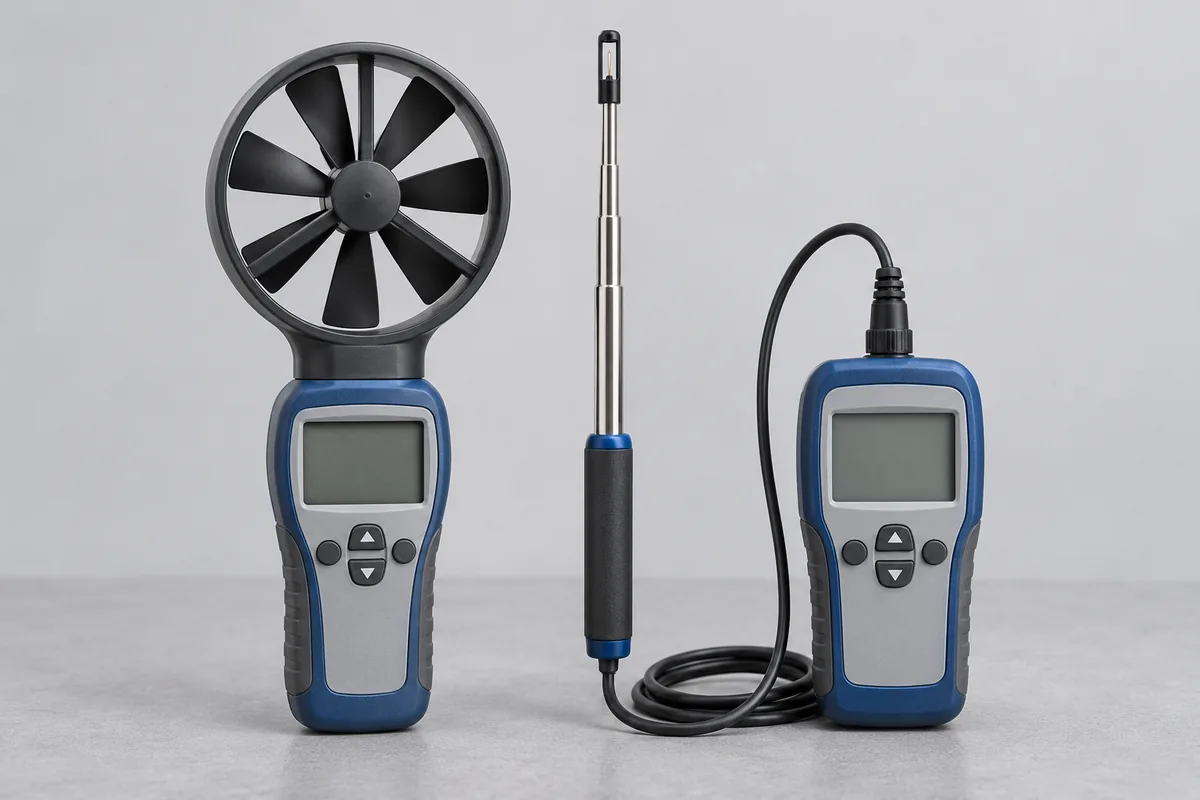
Identify the head and the readout
For a vane model, record the head size and any detachable cable. For a hot-wire model, identify the probe and whether it telescopes. Give the readout serial number and the velocities normally observed, with units. List temperature as an additional channel if it also needs a result.
Describe the work you want priced
A quotation for the portable meter can cover specific velocity points. To request an airflow survey of the installation, identify the duct or outlet, access and the result expected at the site. Include the cross-section used for a displayed flow calculation if that calculation is part of the enquiry.
Preserve the measurement mode
A meter may show an instantaneous velocity, an average or a calculated volume flow. Copy the mode and units used in your records, together with any averaging period or duct dimensions entered into the display. For a probe with a direction marker, include a photograph showing the marker and probe identification. The test arrangement needs to describe the instrument as it is actually used.
If the instrument gives both air speed and temperature, state which channels require results. A damaged vane, bent stem or unstable zero needs to be reported before the job is booked. Ask RTS to identify the agreed reference conditions on the quotation. A laboratory comparison of the meter does not, by itself, establish the flow through a duct whose area and velocity distribution have not been assessed.
Arrange access or dispatch
Mark which probes can leave the plant and when the next ventilation survey begins. Ask RTS where to send the readout and how to protect the sensing head during transport. Include extension cables and any fitted hood in the equipment list if their use is part of the request.
Pitot tubes and differential-pressure instruments
A Pitot tube enquiry should identify the tube geometry, ports, orientation and the differential-pressure instrument used with it. State whether the requested evidence concerns the tube coefficient, its dimensions or the complete velocity calculation. Include the fluid and reference conditions applied by your procedure. Calibration of the pressure instrument alone does not establish the tube coefficient or the accuracy of every installation using that tube.
Air flow calibrators
An air flow calibrator may be the reference used to check another meter or a sampling pump. Give its principle, inlet and outlet arrangement, working flow points and the reference conditions applied to the result. Keep pressure and temperature channels separately identified. RTS should review the complete reference method before accepting the unit; an electrical display comparison alone does not establish the air volume passing through it.
Air flow hoods
For an air flow hood, record the hood size, frame, meter and any correction mode used for supply or return measurements. Include the diffuser type or arrangement relevant to the requested work. A hood changes the measurement configuration, so a detached sensor result may not describe the assembled kit. RTS can review the proposed flow comparison and accepted accessories before you dispatch the equipment or plan a site measurement.