
On this page
Delivery before and after seal or piston work
For a service following seal or piston work, ask for the condition measured before and after adjustment if both are relevant. Keep the body serial number and any removable lower assembly together in the report where those parts are exchanged between instruments.
If successive deliveries become progressively smaller after a piston seal change, retain the individual observations in the job record. A mean alone can disguise a trend through the sequence. Identify the tip type and volume setting associated with the reported behaviour before the instrument goes for service.
Specifications and service checks
If a pipette is routinely set near the bottom of its range, a difference that seems small in microlitres can be a sizeable fraction of the intended delivery. State the working volume and tip type. Include that value alongside the larger settings used for routine checks.
- Range and configuration
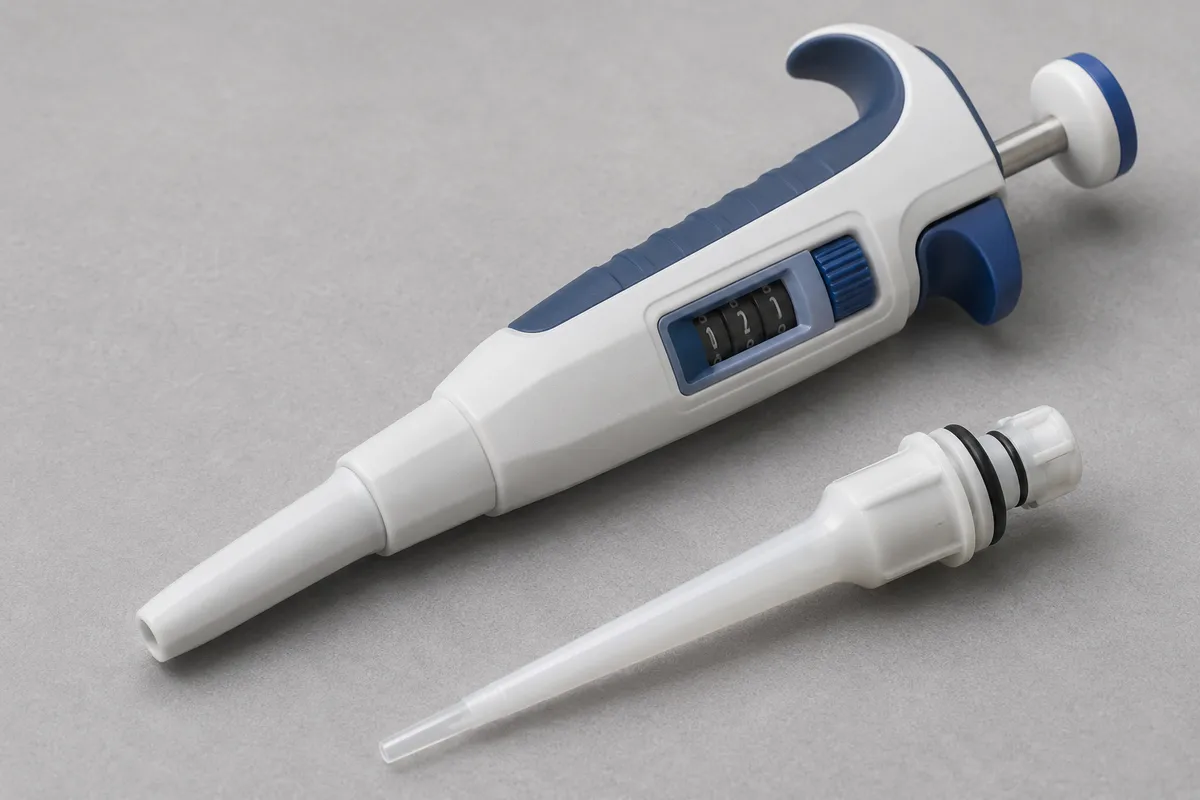
- The Gilson P200 M example spans 20–200 µL. Record both volume limits and the tip specified for the particular pipette. One increment on the volume display is not its allowable delivery error.
- Manufacturers and models
- Gilson PIPETMAN Classic and PIPETMAN M are examples of mechanical and electronic families. The complete model code identifies the volume range.
- What we check
- For a piston pipette, determine the delivered volumes gravimetrically at selected settings. Repeated deliveries give separate estimates of average error and repeatability.
- Reference equipment and accuracy
- Choose a calibrated balance with resolution and uncertainty suited to the smallest delivery. Account for water temperature, evaporation and air buoyancy when converting mass to volume.
- When to repeat the check
- A changed seal, damaged tip cone or volume selector that no longer holds its setting calls for a fresh comparison. Between services, keep results at a familiar working volume.
Technical references Gilson PIPETMAN Classic guide · Gilson PIPETMAN M specifications · ISO 8655-6 gravimetric volume determination