
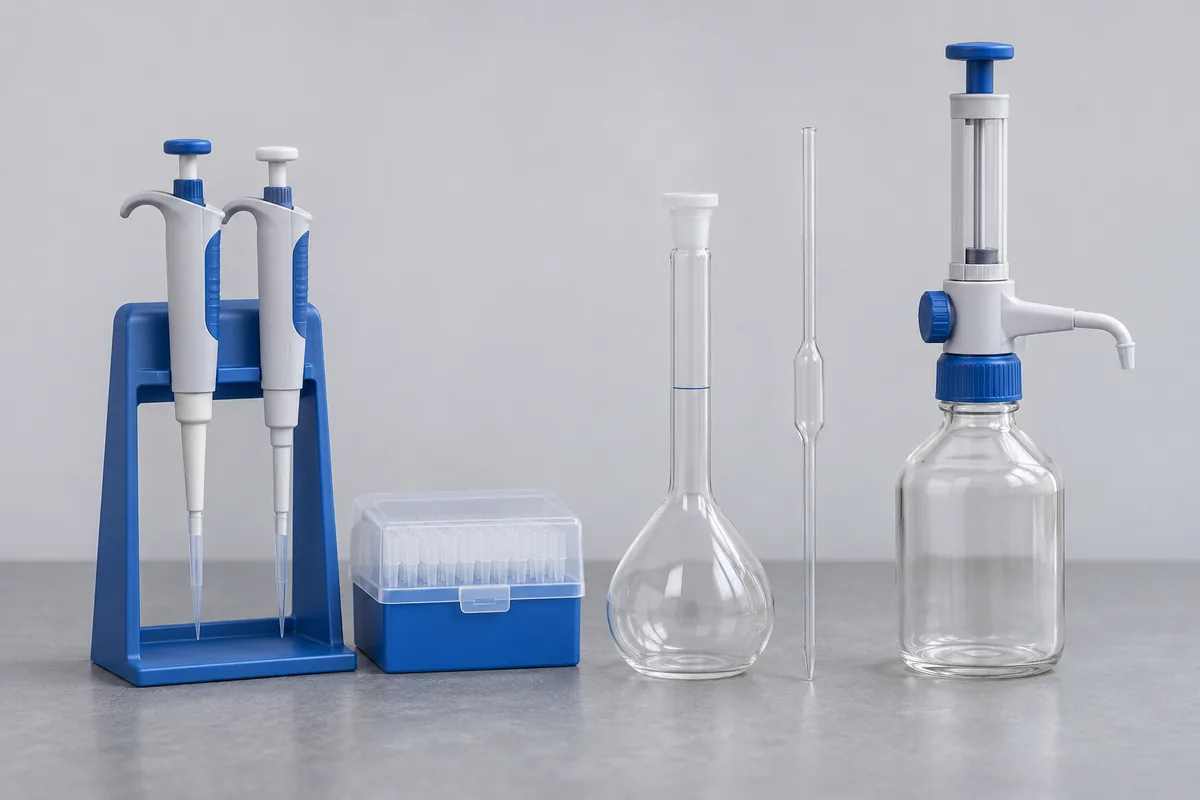
Identify the pipette and the tip
Copy the volume range or fixed volume, model and serial number. Describe whether the pipette is air displacement or positive displacement and give the tip type used in routine work. Mark any channel with a previously observed leak or irregular delivery.
Choose volumes meaningful to the bench
List your usual transfer volumes and any additional points required by your procedure. Clarify whether you want as-received results before adjustment. If a pipette has been used with biological or chemical material, disclose its use and agree on cleaning and release before transport.
Ask for results that show delivery variation
Repeated deliveries allow the reviewer to distinguish the average delivered volume from the variation between operations. Specify the procedure, selected volumes and reporting requirements used by your laboratory, including whether results are needed separately for every channel. A statement covering the whole instrument should make clear which channels and volume settings were actually assessed.
Keep the tip designation with the result, along with any agreed preparation or adjustment record. If the request follows a seal replacement or inconsistent delivery, include the service history and observations already available. Ask for the received condition to be documented where practical, then agree who can authorise further work. A dispenser or bottle-top burette used at the same bench should be listed separately: its delivery assembly and test procedure differ from those of a handheld pipette.
Preparing a batch from sample preparation
Group pipettes by volume for the enquiry, but keep an individual ID for every instrument. Put the return department beside each item and identify any missing or substituted tip accessories. Agree the preparation and receiving arrangements before a batch leaves the laboratory.
Automated liquid handling system and pipetting robot
For an automated liquid handling system or pipetting robot, identify the head, channels, tips and configured liquid-transfer method. State the selected volumes and whether each channel or position requires separate evidence. A handheld pipette certificate does not establish robot positioning or programmed transfers. RTS must review the proposed delivery comparison and automation configuration before accepting the complete system for assessment.
Laboratory syringe volume delivery
Identify a laboratory syringe by its nominal capacity, graduations and delivery mechanism. State whether the method requires contained volume, delivered volume or repeated delivery at a selected setting. Keep the matching plunger and any adapter with the syringe identity. This is a laboratory measurement enquiry; an instrument result should not be presented as approval of a syringe or procedure for patient administration.
Pipette controller used with a separate pipette
A pipette controller supplies suction and dispensing control to a separate pipette. Identify the pipette that defines the transferred volume and any controller condition relevant to the delivery method. The controller alone is not normally the volume reference. If the laboratory needs a comparison of the assembled delivery arrangement, describe that configuration and reporting requirement for review.
Pipette stand and storage identification
A pipette stand supports storage or charging and normally has no measurement function requiring calibration. Record its association with the pipettes if that helps the laboratory maintain a complete inventory. A charging or storage concern should be described as such. The delivery result belongs to the identified pipette and tip arrangement, not to the stand carrying several instruments.
Pipette tip as part of the delivery system
Record the tip designation used for the pipette comparison and the tips used in routine work. Fit and design form part of the delivery arrangement, so changing the tip type can change the meaning of the result. Disposable tips do not normally receive individual calibration certificates. Keep the tested pipette-and-tip combination clear when reviewing volume and repeatability records.