
On this page
Current polarity and small-scale resolution
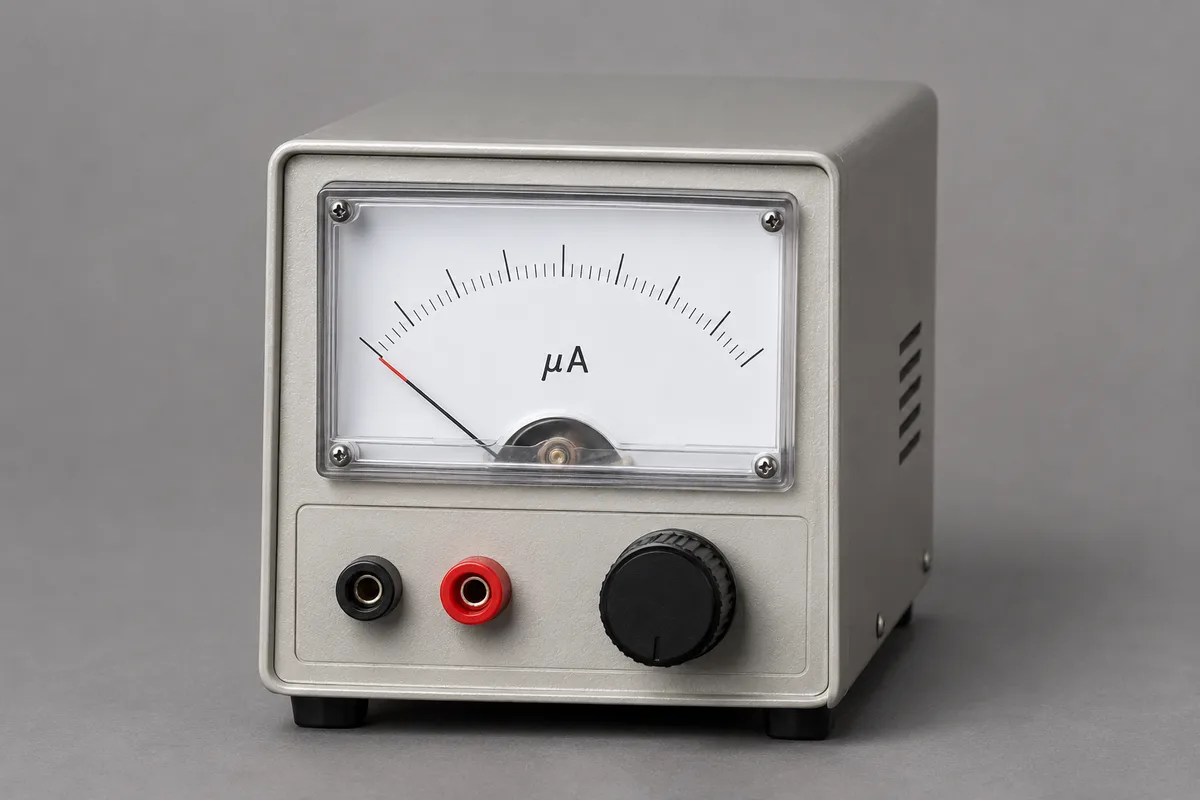
Give the working current values, polarity, input type and resolution. For a centre-zero movement, identify both directions of deflection. If a buffered output or external amplifier is normally used, say whether it belongs in the measurement chain.
If a centre-zero instrument shows an offset with no applied current, look at positive and negative readings separately. An offset of one sign can add to a small positive signal and reduce the magnitude displayed for an equally small negative signal.
Specifications and service checks
A reading that moves only when the test lead is handled can be difficult to reproduce with a bare meter. Note the cable and shielding used in the fixture. At microampere levels, small unwanted currents can be visible on an otherwise stable scale.
- Range and configuration
- A 100 µA movement, a 20 mA loop meter and a 5 A transformer input call for different references. Give the full-scale value, polarity and whether AC or DC is measured.
- Manufacturers and models
- Rishabh's RISH VISTA range illustrates analogue panel instruments. Check whether the scale is direct-reading or set up for an external shunt or transformer.
- What we check
- Compare indication with applied current at several points, allowing an analogue pointer to settle. Include the shunt or transformer if the installed measuring chain is required.
- Reference equipment and accuracy
- Use a stable low-current source or a characterised resistance and voltage combination. At microampere levels, insulation leakage, cable contamination and zero offsets can appreciably alter the result.
- When to repeat the check
- Track zero error and repeatability. After a shunt or movement change, verify the complete scale again.
Technical references 212, 312 and 412 RISH VISTA Series Analog Panel Meters