
On this page
Mean volume and repeatability
Tell us the tip family and how close the routine volume is to the bottom of the pipette range. Across repeated deliveries, the mean shows how close the pipette comes to the setting. The spread shows how consistently it delivers.
A 0.2 µL difference is 2% of a 10 µL setting but only 0.2% of a 100 µL setting. For a pipette used at both volumes, show the selected volume beside each absolute or percentage result. The same absolute difference does not carry the same significance.
Specifications and service checks
A pipette can give ten closely grouped deliveries that all fall slightly below the selected volume. State whether the concern is the average size, the spread between deliveries or both. A sequence of individual readings answers that question more clearly than a single combined total.
- Range and configuration
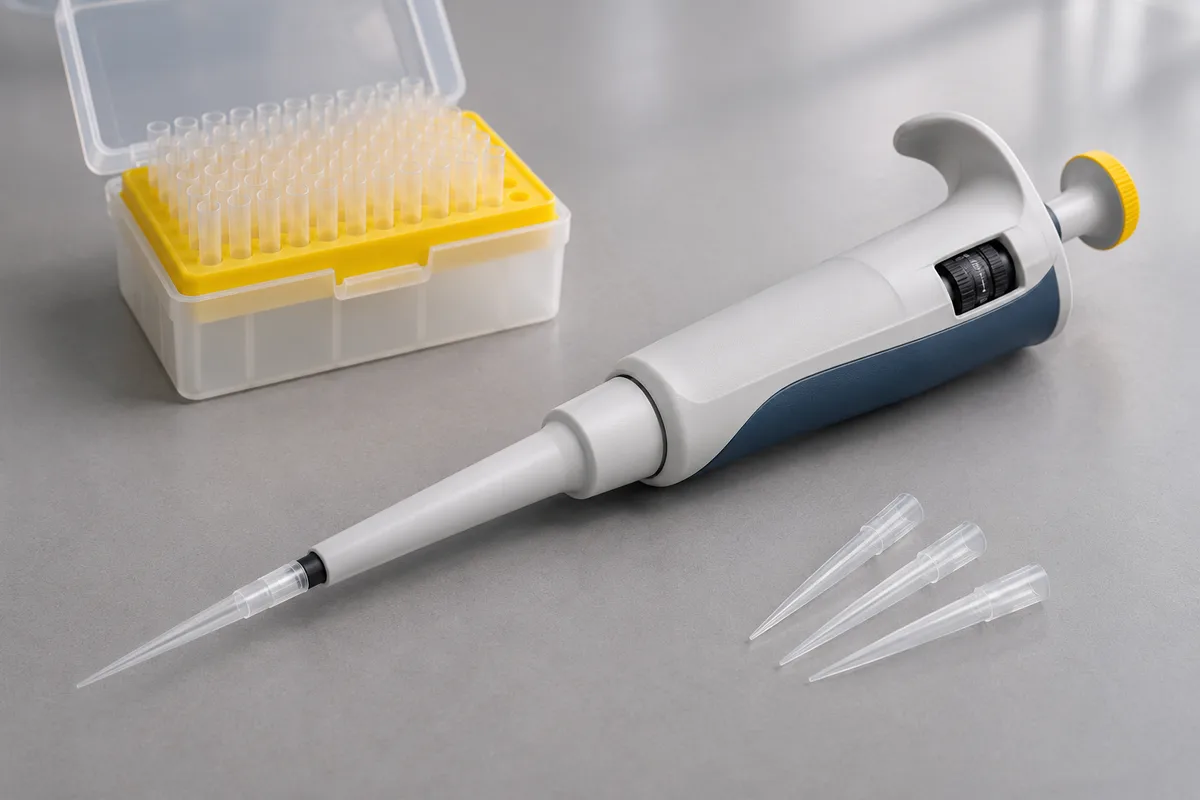
- The Gilson P200 M example spans 20–200 µL. Record both volume limits and the tip specified for the particular pipette. One increment on the volume display is not its allowable delivery error.
- Manufacturers and models
- Gilson PIPETMAN Classic and PIPETMAN M are examples of mechanical and electronic families. The complete model code identifies the volume range.
- What we check
- For a piston pipette, determine the delivered volumes gravimetrically at selected settings. Repeated deliveries give separate estimates of average error and repeatability.
- Reference equipment and accuracy
- At the low end of a micropipette range, choose a balance that resolves the delivered mass and account for evaporation during weighing. A calibration certificate for a high-capacity bench balance alone cannot show suitability.
- When to repeat the check
- Use the frequency of use, local checks and previous results to set recall. Give a leaking or repaired pipette a fresh check before returning it to the bench.
Technical references Gilson PIPETMAN Classic guide · Gilson PIPETMAN M specifications · ISO 8655-6 gravimetric volume determination