
On this page
Detector head and the light quantity in use
Give the target quantity, detector head and source type used in your process. If the instrument is part of a fixed optical bench, include the aperture, working distance and any filter. These details establish what optical input is compared with the indication.
Reading lux at a work surface and reading luminance from a lit display answer different optical questions. If the department calls both devices photometers, photograph the detector and the displayed unit to make sure the comparison addresses the quantity used for release.
Specifications and service checks
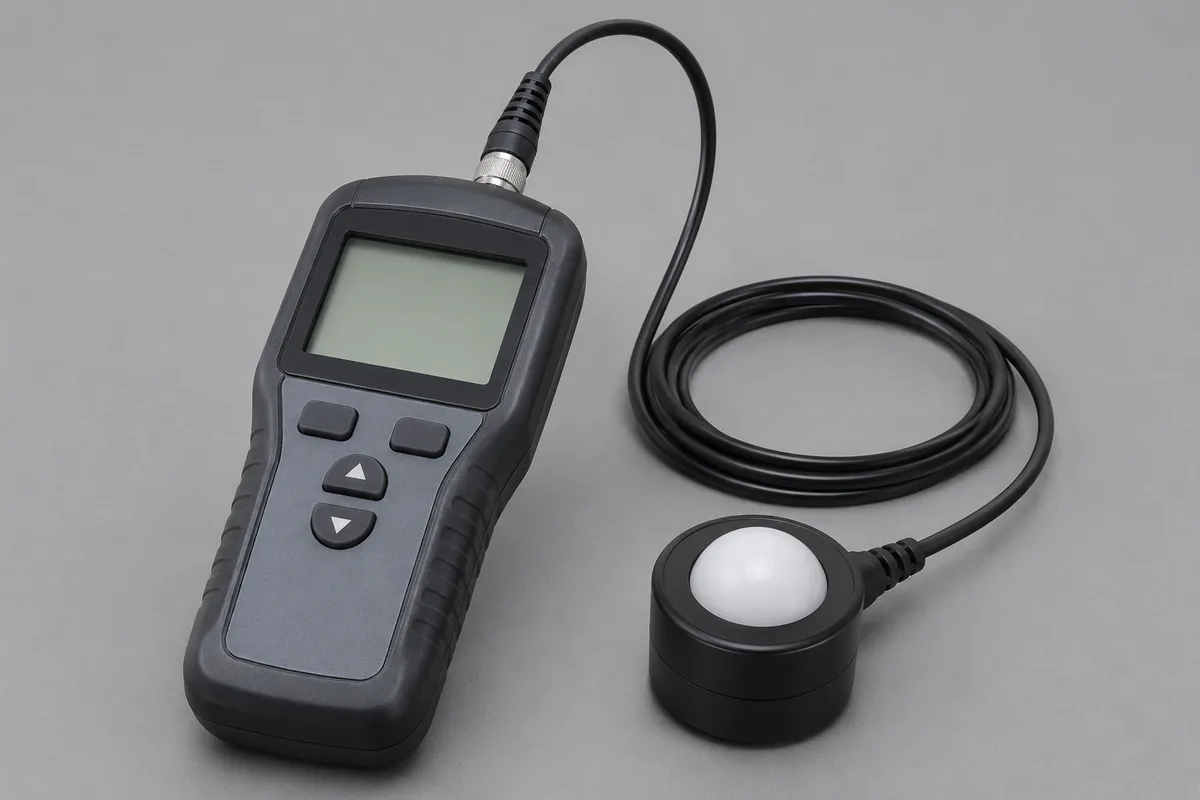
In a setup with both a detachable detector head and a readout, changing the head may require a different stored factor. Identify the head and active setting together. A reading change after a head swap may be a matching issue rather than a drift of the display.
- Range and configuration
- A head matched to the photopic response can report illuminance in lux. An irradiance head uses different units and spectral responsivity.
- Manufacturers and models
- Gigahertz-Optik's X1 meter accepts detector heads for different optical quantities. Identify the head as well as the display.
- What we check
- Compare the assembled head and meter at known levels with a defined source spectrum. Check each readout range used at the bench.
- Reference equipment and accuracy
- Use a calibrated reference photometer or characterised optical source with compatible geometry and spectral response.
- When to repeat the check
- Recheck after a head substitution or diffuser damage. Keep the detector calibration factor paired with the correct serial number.
Technical references Gigahertz-Optik X1 meter and detector heads