
On this page
Probe type and the hardness scale shown
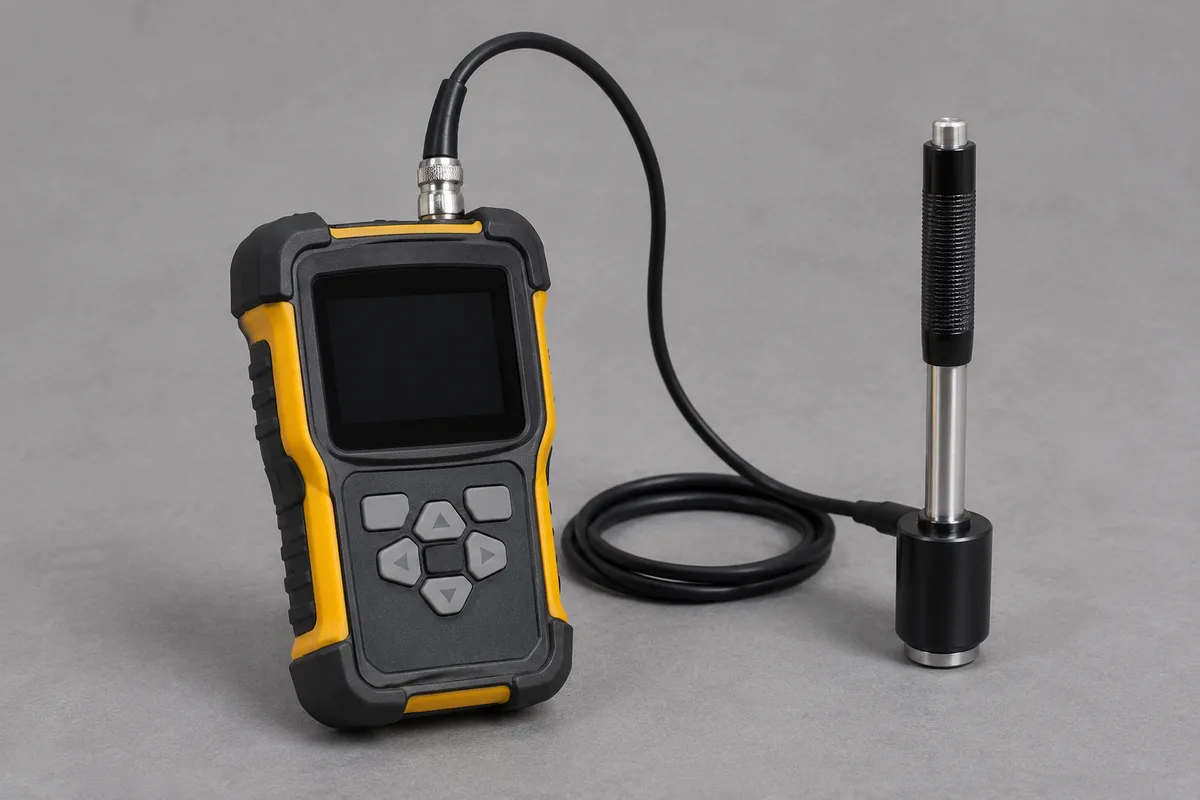
Give the method or model marked on the probe and the scale displayed before conversion. Include extension leads or supports used on site. A disagreement on a thin, curved or small part should identify the part geometry and how the operator supported it.
A portable unit can show a converted scale familiar from the bench tester, yet use a different measuring principle. When the two disagree, keep the native reading, conversion selection and support condition of the portable test beside the bench result.
Specifications and service checks
A curved pipe wall gives a different seating condition from a flat reference block. Keep the probe or impact-device type, support ring and pipe diameter with a disputed field reading so the applicable method can be identified.
- Range and configuration
- A Leeb result carries the impact-device designation, such as HLD. The useful range depends on the material, impact body and orientation. Other portable designs use indentation or ultrasonic contact impedance.
- Manufacturers and models
- Screening Eagle’s Equotip 550 Leeb uses interchangeable impact devices. Portable hardness testers based on other principles need their own references.
- What we check
- Identify whether the device uses Leeb rebound, ultrasonic contact impedance or indentation. Verify the native scale using a reference for that method and the fitted probe. A conversion to HRC or HV is an additional function to assess.
- Reference equipment and accuracy
- Use a certified block appropriate to the impact device, hardness and orientation. The block must be supported as specified for valid rebound measurements.
- When to repeat the check
- Inspect the impact tip and repeat a block check after cleaning the guide tube or changing the impact device. Keep results in the native scale for tracking drift.
Technical references Screening Eagle Equotip 550 Leeb