
On this page
Stem dimensions and mounting position
Choose temperatures around the part of the scale on which operators make decisions. Record the immersion available in the installed pocket and any pointer adjustment made after the initial readings, so maintenance can compare the as-found and final indications.
If a replacement gauge has the same face range but a shorter stem, it may occupy a different part of its pocket. Give the original and replacement stem lengths when describing a new discrepancy. A good bench result alone cannot establish identical installation conditions.
Specifications and service checks
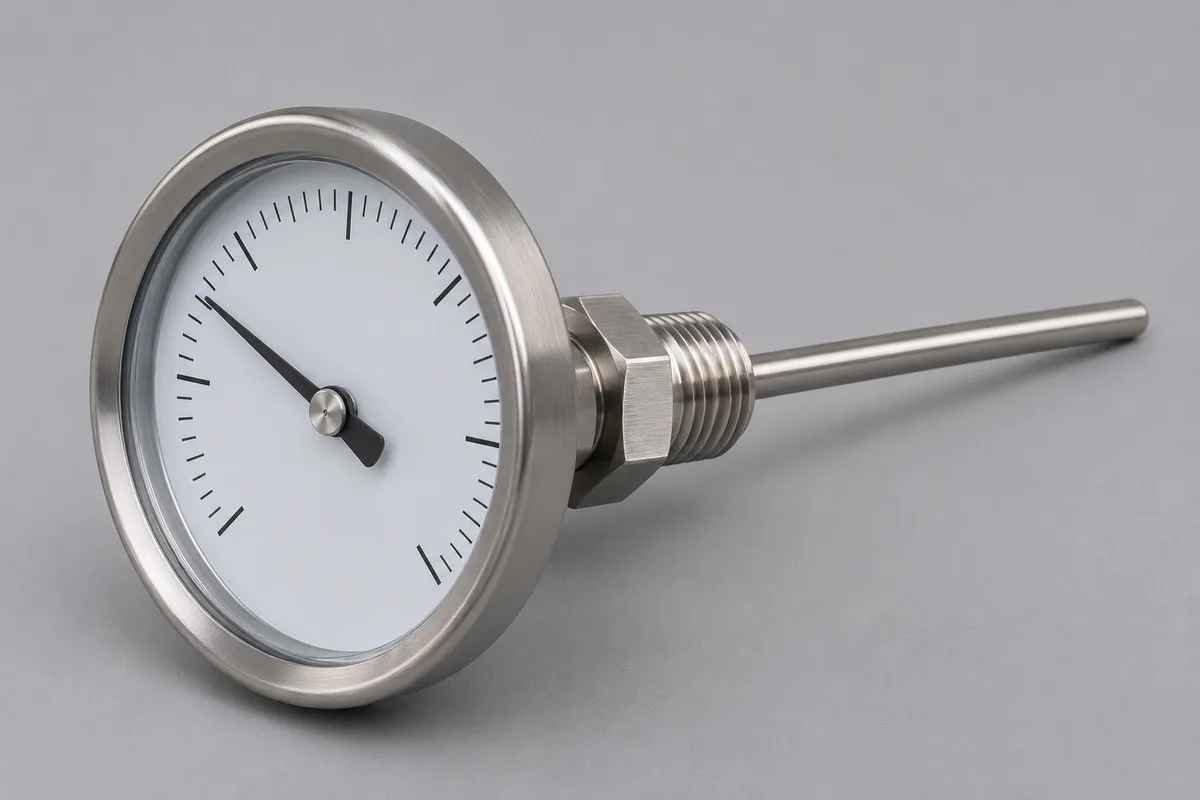
A stem gauge removed from a pocket may carry a handwritten normal mark as well as a printed scale. Give the temperature represented by that mark and the usual immersion length. It identifies both the range the operator reads most often and the installed sensing arrangement.
- Range and configuration
- WIKA’s A52 and R52 bimetallic gauges offer scales across −30 to +500 °C. The chosen dial scale and stem configuration determine the points and immersion suitable for the individual gauge.
- Manufacturers and models
- WIKA’s A52 and R52 are bimetallic thermometers. Its model 73 uses gas actuation.
- What we check
- Compare the gauge with an independent thermometer at stable temperatures and record the immersion used. Note any difference on returning to a previously checked point.
- Reference equipment and accuracy
- A stable bath or appropriate dry block and a calibrated reference probe establish the comparison. Large divisions limit how closely the pointer can be read.
- When to repeat the check
- Review the gauge after a bent stem, loose pointer or change in thermowell. For routine work compare its drift with the permitted process error.
Technical references WIKA A52 and R52 specifications · WIKA model 73