
Identify the thermometer
Give the model and say whether it has a fixed stem, a detachable probe or a separate indicator. For a dial instrument, include a photograph of the scale. If yours is an infrared thermometer, identify it in the request so the team can review that measurement separately.
Working temperatures and immersion
List the temperatures from your process sheet with their units. Give the probe or stem length and diameter, any immersion marking and any limit on how far the stem may be inserted. Include a drawing or model number for an unusual fitting.
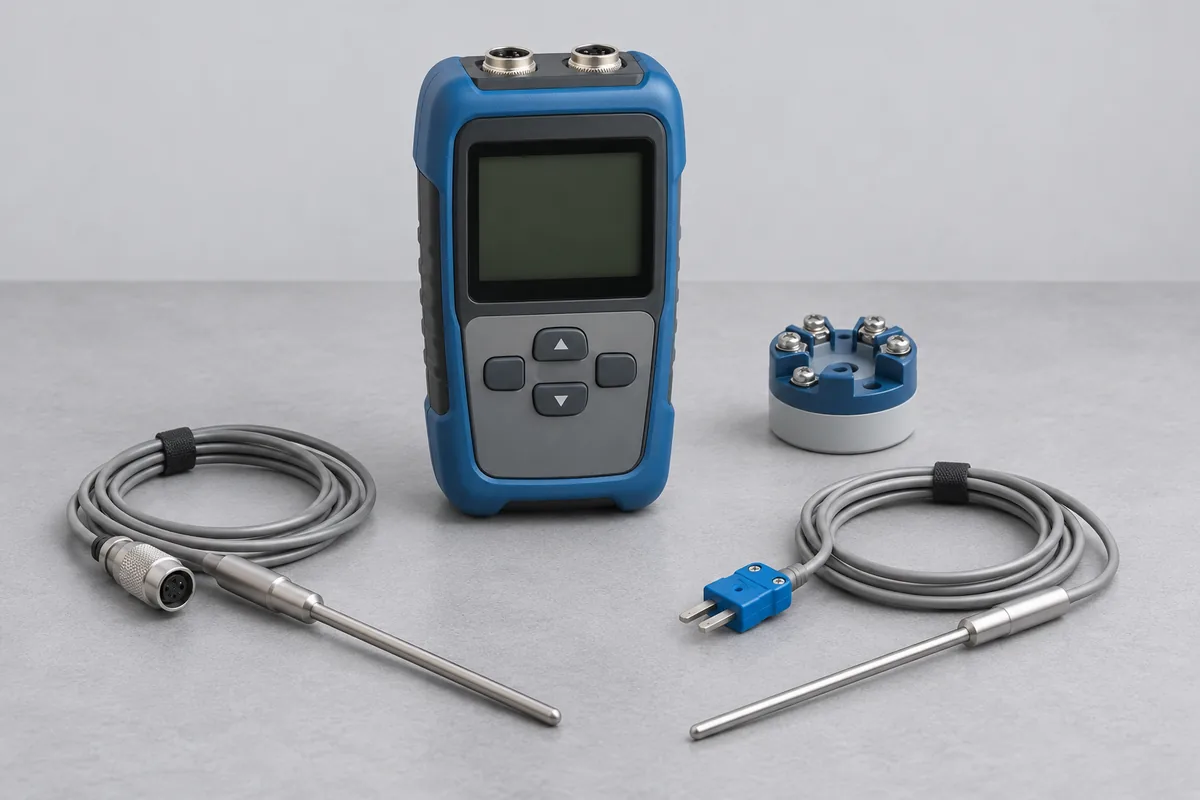
A handheld reader with interchangeable probes
Two probes in a carrying case may have different jobs. A short surface probe checks a hot plate while a long immersion probe follows a liquid bath. Write the working temperature and probe ID on separate lines under the reader serial number. If the old report lists one combination only, mark the other as an addition.
Where a probe stops at a shoulder or fixed clip, a photograph beside a ruler can show the usable stem length. Also identify a handle, lead or connector that needs to remain outside the bath when the probe is used.
Liquid-in-glass thermometers and immersion markings
For a glass thermometer, photograph the full scale, identification and immersion marking. State whether the instrument is marked for partial or total immersion and give the stem length. Those details determine how the comparison is arranged. A support clip that fixes the stem at a particular depth should be identified with the thermometer. Mention a separated liquid column, damaged scale or crack before dispatch so the receiving team can review its condition.
CC-4643 lists liquid-in-glass thermometer comparison from 50 to 250 °C under both permanent and site facilities. List the actual points needed within the instrument's marked working range. If the process uses a different immersion from the instrument's marking, explain that use when requesting the quotation rather than assuming one result describes both arrangements.
Keep the serial number or permanent tool mark with the case, especially when several thermometers have similar scales. For a laboratory at IMT Bawal, give the bench contact and the points used in that laboratory. RTS can agree the receiving location and reporting instructions before the batch travels.
Multiple probes on one readout
Record which probe goes with which channel, especially where probes are swapped between lines. Tell us whether the certificate needs to identify each pairing.
Clinical thermometers: identify the measurement mode
A clinical thermometer enquiry should state contact or infrared operation, model and the manufacturer's verification mode. Include the required temperature points and any dedicated probe or reference accessory. Predictive or adjusted display modes need their own procedure and should not be treated as an ordinary industrial indication. RTS will review the suitable service route and method before acceptance; this enquiry does not establish a product approval or clinical-performance claim.