
On this page
Field-book angles and instrument face
Record the angles and units used by the survey crew and whether the check should include the line of sight, vertical index or plummet. If the instrument is used with a removable tribrach, identify that pairing. Face and orientation labels make repeat observations easier to interpret.
When you report a difference between two sights, write the angles exactly as read. A minute of arc and a decimal fraction of a degree can both look like digits after a separator. Include the face used for each reading and whether the instrument displays degrees or gon. A field-book extract makes the format clear.
Specifications and service checks
A face-left observation differs in meaning from an isolated face-right value. Keep the instrument face, target and angle convention with the observations so the lab can interpret paired readings from the same sight.
- Range and configuration
- The identifying figures are horizontal and vertical angular accuracy and the least display step. The model suffix can change the accuracy class.
- Manufacturers and models
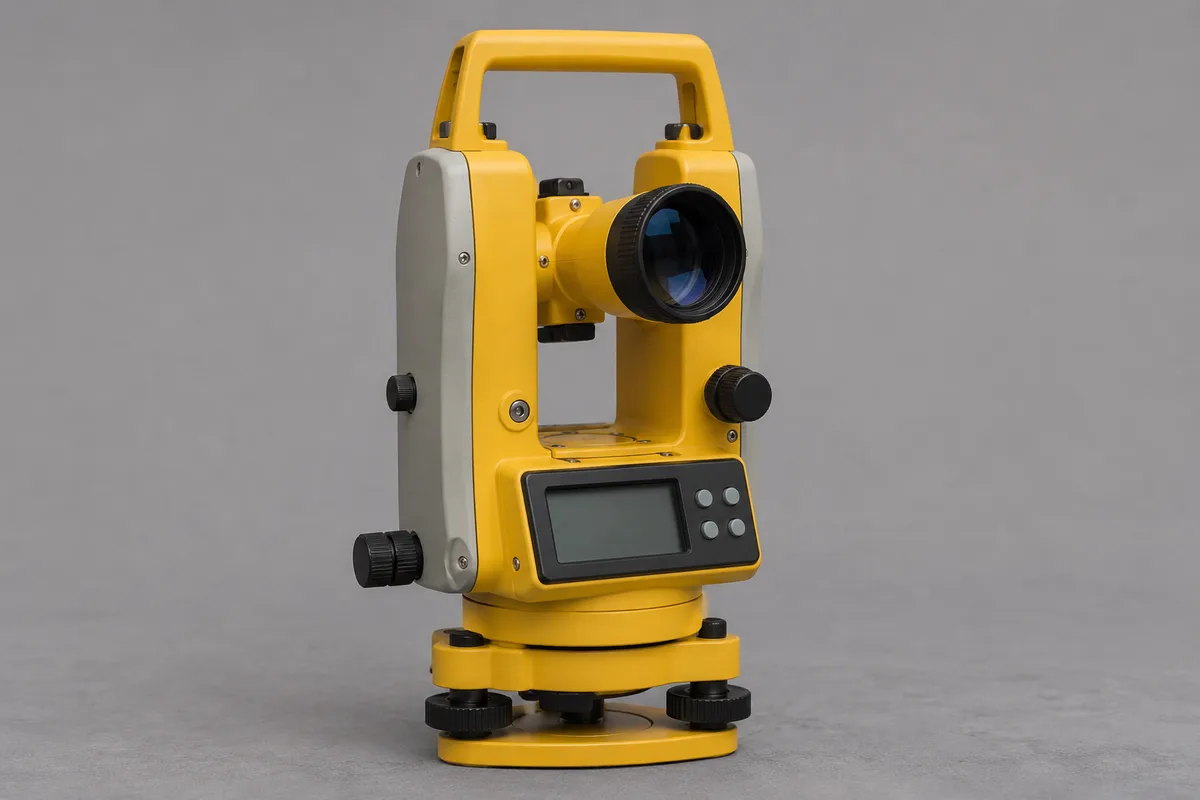
- Topcon DT-300 is a digital theodolite series. Another example is the geo-FENNEL FET 220K-L.
- What we check
- Compare circle readings against known directions and evaluate face reversal, index error and repeatability. Record the angle convention used.
- Reference equipment and accuracy
- Use a traceable angle reference and stable collimators. A visual target alone does not establish a calibrated angular separation.
- When to repeat the check
- Check after adjustment or a fall and review historical errors before scheduling the next laboratory comparison.
Technical references Topcon product reference · geo-FENNEL product reference