
On this page
Which way the airflow meets the vane
Suction and discharge measurements may use different orientations. A record of the direction used, individual speed points and matching display is more useful to a ventilation technician than a single pass mark beside the instrument tag.
An air velocity of 2 m/s over an area of 0.1 m² would represent 0.2 m³/s if the speed were uniform and normal to the area. That calculation illustrates why checking the vane reading alone does not validate a volume figure calculated using an incorrect duct area.
Specifications and service checks
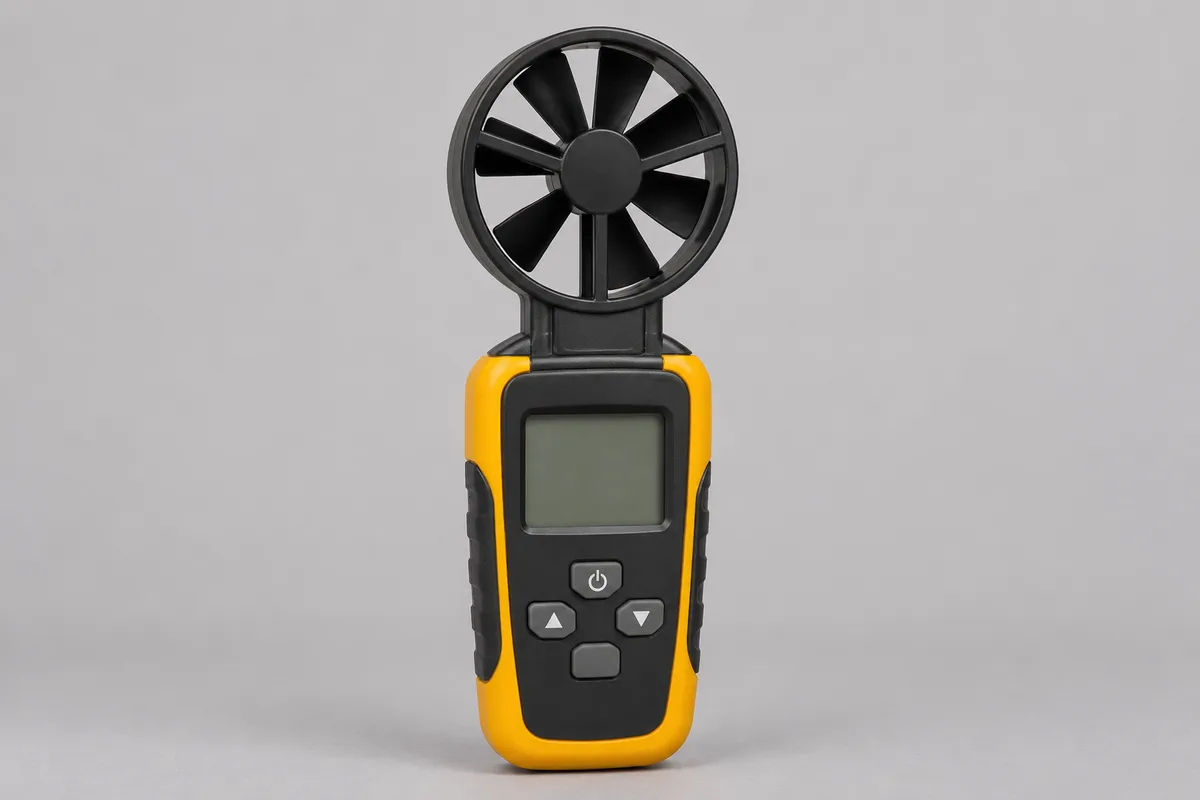
A large vane can almost fill a small grille opening, while a compact vane samples only a part of it. Give the rotor diameter and intended use when selecting the check. For an area-averaged survey, retain the pattern of positions as well as the indicated air speeds.
- Range and configuration
- The Testo 410i has a specified air-speed range of 0.4–30 m/s. At the slow end, reluctance of the rotor to start can matter more than the display increment.
- Manufacturers and models
- Testo lists the 410i vane anemometer alongside its 405i hot-wire model.
- What we check
- Check the rotor and its readout together in a calibrated flow at the speeds used. Include the rotation direction or reverse-flow mode if the instrument supports it.
- Reference equipment and accuracy
- Use a characterised air stream with a traceable air-speed reference. Allow for alignment and the space occupied by the rotor and housing.
- When to repeat the check
- A rotor that starts reluctantly, has been dropped or has had bearings replaced needs checking earlier than the routine date.
Technical references Testo 405i and 410i metric specifications · NIST air speed metrology