
On this page
Sensor units and the frequency band
Identify the sensor, conditioning, units and analysis band used to diagnose the machine. If the acceptance limit applies to an individual spectral line, give its frequency and amplitude convention. A broadband overall reading answers a different question.
A machine acceptance limit given in overall RMS velocity cannot be compared directly with the peak acceleration of a single spectral line. Identify the unit, amplitude convention and band for the reported quantity before deciding whether a limit was exceeded.
Specifications and service checks
If a spectral peak changes height when the operator selects a different window, retain both window names, amplitude units and sampling conditions. The comparison concerns signal processing as well as input sensitivity, particularly for tones that fall between frequency bins.
- Range and configuration
- Specify which channels, amplitude units, frequency band and spectrum settings matter for the asset. A single overall level does not describe frequency-analysis performance.
- Manufacturers and models
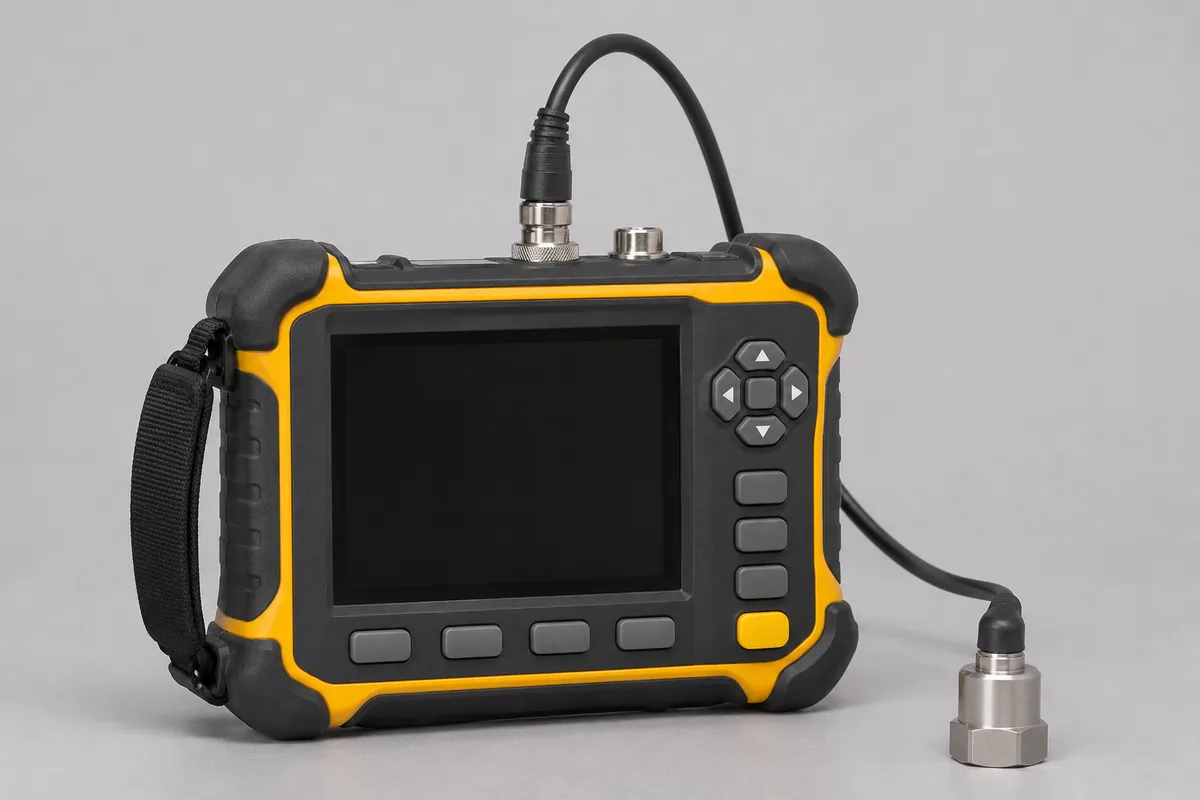
- SKF Microlog Analyzer dBX is an example of a multichannel vibration analyser. Include its external pickup if the whole chain is to be assessed.
- What we check
- Compare the indicated spectrum against known vibration or an electrical test signal, identifying which parts of the chain are included.
- Reference equipment and accuracy
- Use a calibrated accelerometer and exciter for the mechanical chain, or a traceable signal generator and amplitude reference for an electronics-only check.
- When to repeat the check
- Review following replacement of a pickup, input module or firmware affecting signal processing. Monitor a repeatable reference signal between calibrations.
Technical references SKF Microlog Analyzer dBX