
On this page
Which fill line is in use?
If your laboratory has added a fill line or replaced a mark, show us the line you use. A result at that line concerns the liquid contained at the mark. Pouring the contents into another vessel is a separate delivery operation.
If two flasks marked 250 mL have different measured corrections, the figures belong to the individually identified pieces. Keep the report reference with each flask. Relabelling them only as “250 mL flasks” after calibration makes the corrections impossible to apply confidently.
Measuring flask
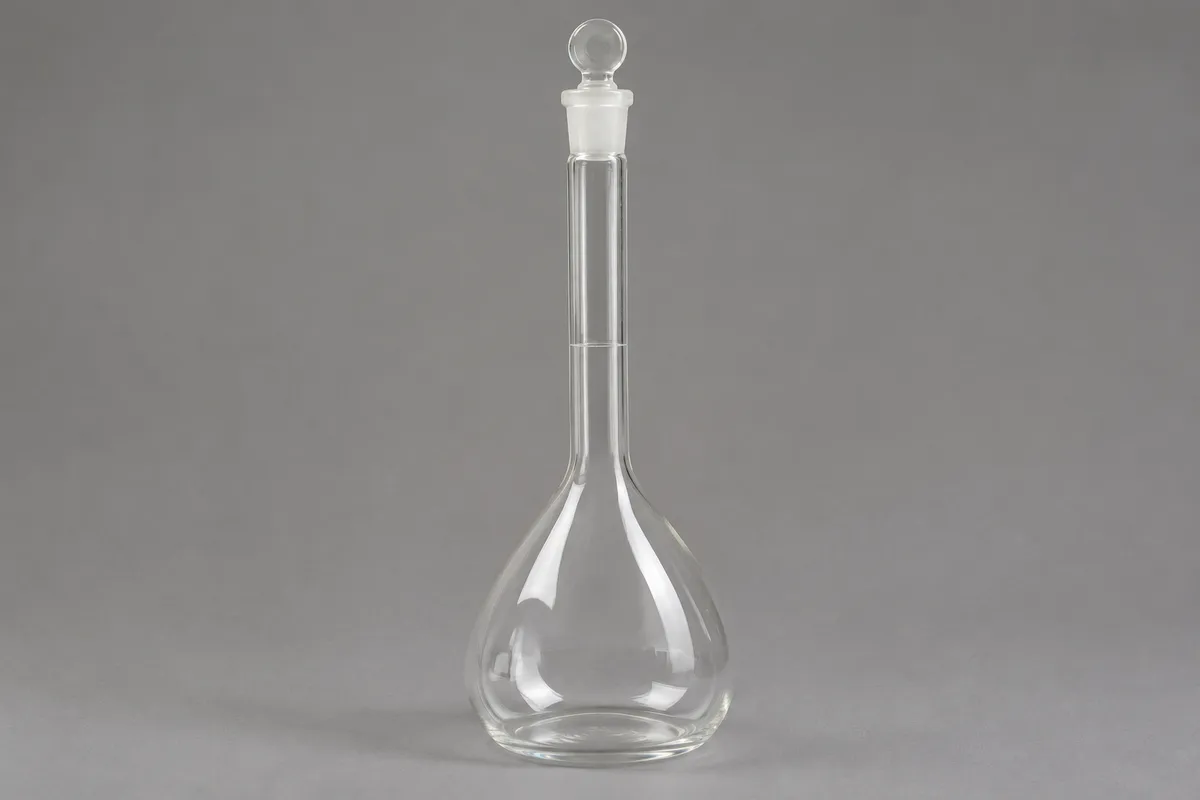
When measuring flask means a flask with an assigned fill line, record the capacity and the temperature engraved on the neck. For unmarked mixing flasks, identify the vessel by its actual design.
If a flask is filled to its line and the contents are then poured into another vessel, a small film can remain on the walls. Check the contain/deliver marking on the glass. It determines whether the job should compare the liquid held at the mark or the amount delivered.
- What we check
- For a one-mark flask, determine the water volume contained at the etched line. Record reference temperature and the individual flask identifier where one is etched.
Shared with Volumetric flask — Range and configuration · Manufacturers and models · Reference equipment and accuracy · When to repeat the check · Technical references
Specifications and service checks
A 100 mL flask marked to contain holds its assigned volume at the fill line and reference temperature. If the contents are poured away, some liquid normally remains on the glass. Read the marking on the neck when deciding whether a fill or a delivery measurement is needed.
- Range and configuration
- The DURAN 1,000 mL Class A flask cited here has a stated tolerance of ±0.4 mL. Use the marked class, reference temperature and nominal size of the actual vessel.
- Manufacturers and models
- DWK DURAN and BRAND BLAUBRAND supply individually identifiable volumetric glassware.
- What we check
- Determine volume gravimetrically at the reference temperature. A flask is normally marked to contain, while a pipette or burette may be marked to deliver. Record the marking used.
- Reference equipment and accuracy
- Use a calibrated balance and temperature measurement suited to the required volume uncertainty. Allow for density, buoyancy and meniscus reading as applicable.
- When to repeat the check
- Review the condition of the mark, neck and stopper after damage or harsh treatment. Keep any individual certificate tied to the etched identification.
Technical references DWK DURAN 1,000 mL Class A flask · BRAND volumetric glassware testing guide · NIST volumetric calibration procedures