
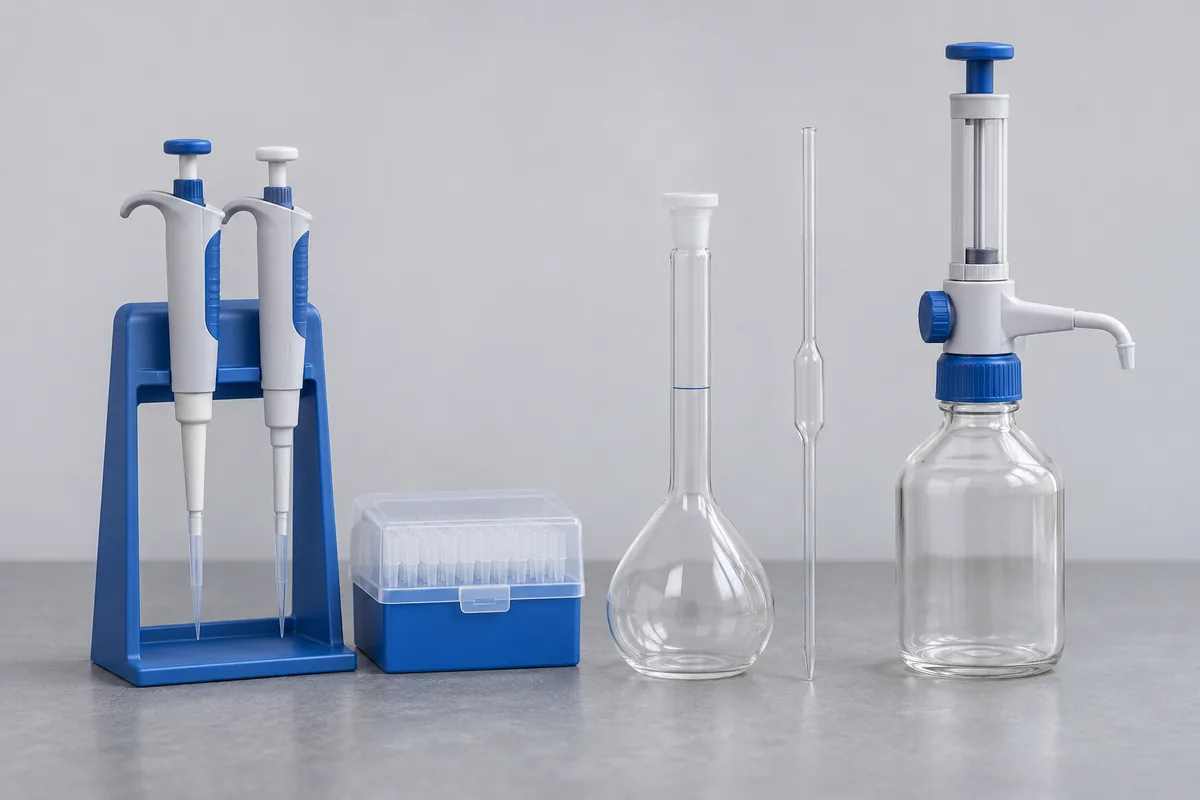
Read the glass markings
Copy the nominal capacity, class if marked, reference temperature and the contain or deliver marking, such as IN/TC or EX/TD. For a graduated item, name the marks to be checked. Note any specified waiting period where delivery is part of the procedure.
Make individual results traceable
If ten flasks have the same capacity, give each a durable reference that your laboratory can recognise. Flag chipped rims, faded graduations or damaged stopcocks before packing. Confirm which pieces can be accepted and agree on transport for clean, dry glassware.
What the etched line means
Look for a mark such as IN or TC on a flask and EX or TD on delivery glassware. These tell the laboratory whether the marked volume is intended to be contained or delivered. Copy any stated reference temperature and, on delivery pieces, any waiting time printed beside the markings. A photo helps when the scale or text has started to fade.
For a graduated pipette or cylinder, put the actual graduations used in the request. If one cylinder is used for two sample sizes, a result at its top line alone may leave the smaller measure undocumented.
Returning a glassware batch
For a Rohtak sample room, use its rack or cupboard reference alongside the asset ID. If the billing address differs from the receiving laboratory elsewhere in India, put the receiving address on the list.
Beaker graduations and actual volume requirements
A beaker often provides approximate graduations for handling liquids rather than the defined volume function of volumetric glassware. State whether the laboratory needs a particular contained volume established or simply uses the vessel during another measurement. Include the marked size and required uncertainty for review. Do not assume every printed graduation warrants the same certificate as a volumetric flask.
Conical flask used as a receiver or vessel
A conical flask may serve as a mixing vessel, titration receiver or a container with approximate markings. Describe its actual role before requesting calibration. If a defined contained volume is needed, identify the filling condition and required result for review. A flask used only to receive a titrated liquid is not automatically the instrument that determines the reported delivered volume.