
On this page
What the wet and dry teeth tell you
Suppose the 75 µm tooth is wet and the 100 µm tooth is the next one dry. The comb brackets the film between those values. It has not measured an exact thickness of 75 µm. For a check of the comb itself, identify the range and the teeth used most often. If your painter uses a wheel, send the track and scale designation instead.
Wet film thickness gauge geometry
Copy the marked graduations and specify the steps or measuring geometry requiring examination. A wet-film tool works differently from an electronic dry-coating gauge. RTS measures the wet-film gauge’s specified dimensions and examines the contact features separately from an electronic coating-gauge comparison.
Specifications and service checks
A four-sided comb can have a different graduation band on each edge. Mark the side that touched the coating and the pair of teeth bracketing the wet film. A single rounded figure loses the spacing available on that edge.
- Range and configuration
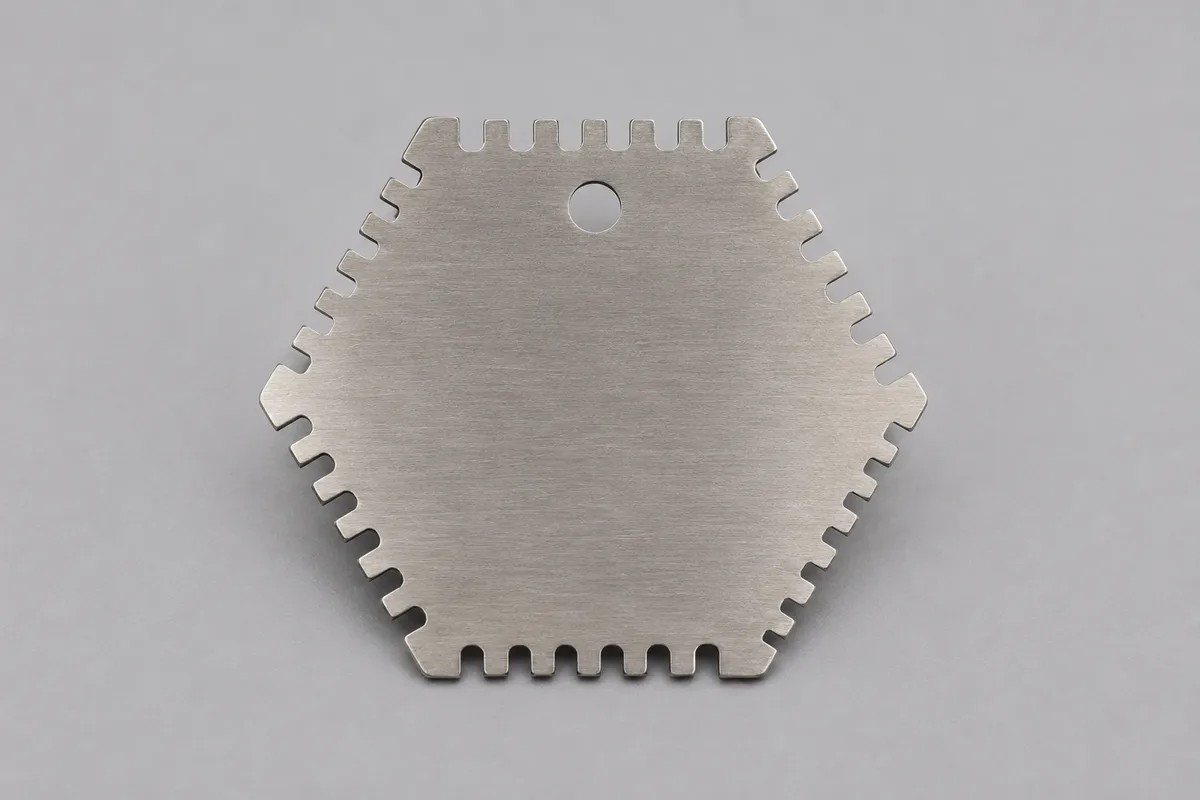
- Elcometer’s hexagonal combs have 24 or 36 steps depending on the version. Some extend to 3,000 µm. Each step brackets a thickness between adjacent teeth.
- Manufacturers and models
- Elcometer 112 and 3236 are stainless steel wet-film comb families.
- What we check
- Inspect the end supports and compare the height of each working tooth with the reference plane. Identify damaged teeth individually because other steps may still be usable.
- Reference equipment and accuracy
- Use a calibrated optical or contact dimensional system suitable for tooth geometry. Reference uncertainty must be small enough to distinguish adjacent step heights.
- When to repeat the check
- Recheck after a bent tooth, rework or a fall. Cleaning that abrades the supports can alter every tooth relative to the datum.
Technical references Elcometer 112 & 3236 Hexagonal Wet Film Combs (Stainless Steel)