
On this page
Repeatability at the working load
List the nominal loads you actually compare and how the weights are exchanged. A series of reference and test weighings reveals the spread in the measured difference. Recording their order helps the laboratory account for drift between successive readings. For an automatic comparator, identify the pan positions and exchange cycle used in routine work.
Response to a small change in mass
A small, known increment added near the working load checks how the indication responds to a change of that size. Include the available sensitivity weight and its certificate details when arranging the check. The size of the display division alone tells little about the scatter observed after unloading and reloading the comparator.
Comparator results and weight certificates
A result for the comparator describes the instrument used for weighing. If you also need assigned values for the weights in the cabinet, identify each weight and include it on the order. For an installed comparator, describe the weighing table and enclosure. If your mass comparisons include an air-buoyancy correction, tell us which environmental readings you record during a run.
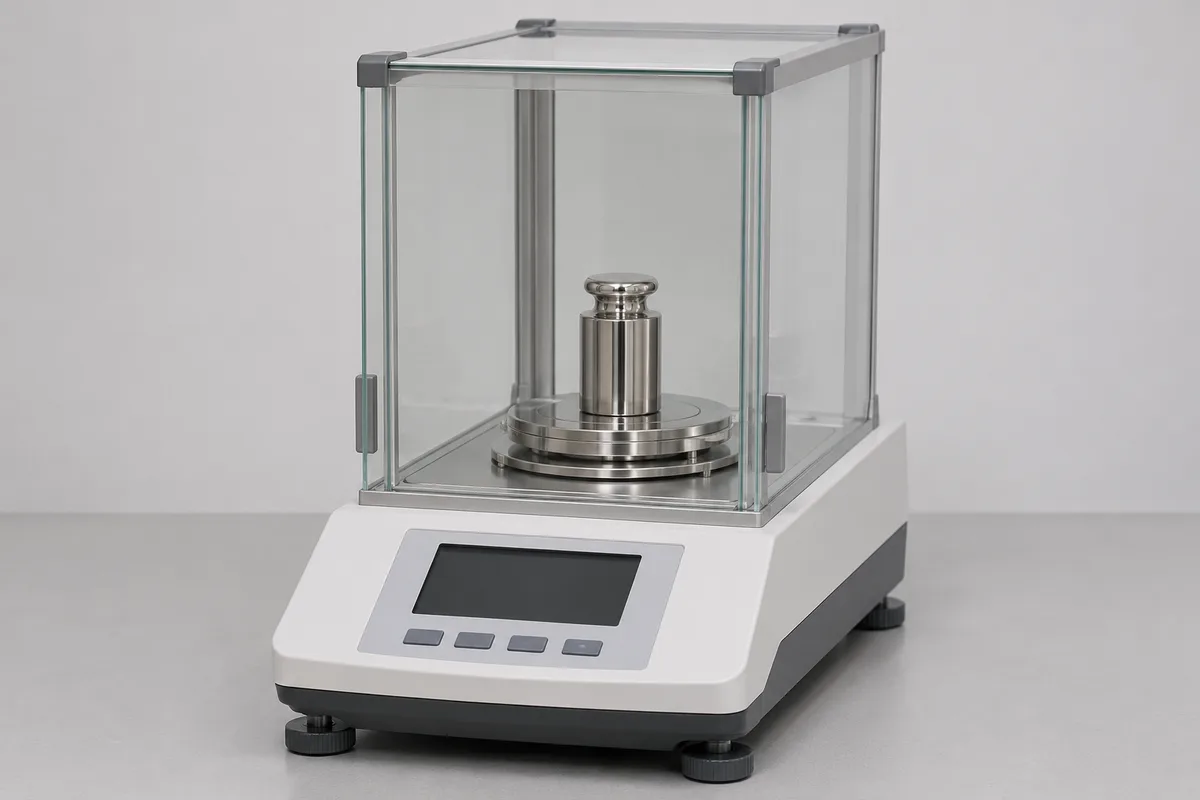
Mass comparator
Tell us how small a difference the operator has to resolve at the working load. Comparing two nominally 1 kg weights, for example, exercises repeatability near 1 kg. A list giving only the comparator’s maximum capacity misses that point. The reference and test loading sequence will also help us reproduce the comparison.
In a comparison sequence the reference and test weight can be nearly equal even on a high-capacity instrument. The important working span is the small difference around the nominal load. Record that difference alongside the total load.
- Range and configuration
- The instrument has a maximum load and a much smaller comparison window around the nominal load. Give the weight denominations and differences the laboratory normally compares.
- Manufacturers and models
- Sartorius Cubis II manual mass comparators are examples. Quote the full configuration and its external or internal range arrangement.
- What we check
- Check repeatability of differences under substitution near the working load. Characterise sensitivity with a small calibrated addition to that load.
- Reference equipment and accuracy
- Use stable comparison weights and a calibrated sensitivity weight. Select the system from the uncertainty allowed for the smallest mass difference.
- When to repeat the check
- Track the standard deviation of routine comparisons. Changes to the pan, environment or loading mechanism may call for a fresh evaluation.
Technical references Sartorius Mass comparator reference