
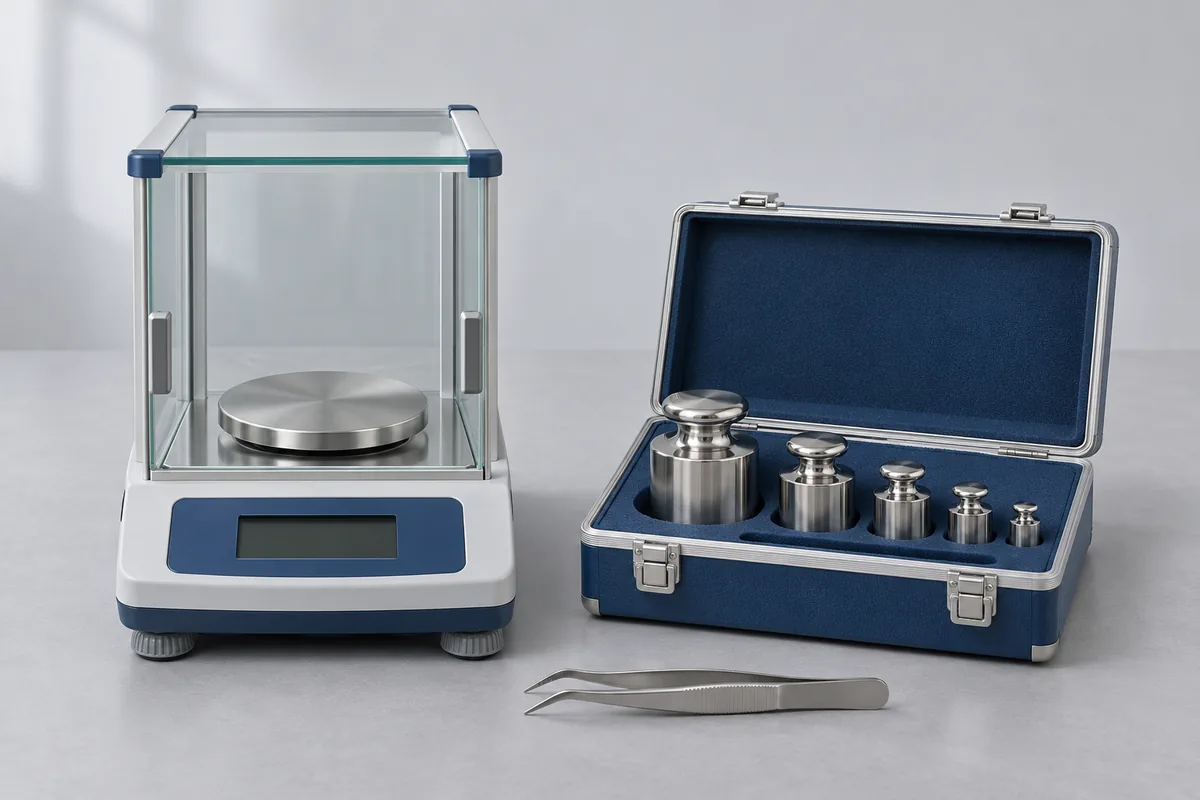
Capacity and readability
Copy the maximum capacity and smallest displayed increment from the balance. Include the units for both. If the display step changes with load, send the model or a picture of the rating label so the team can identify the ranges.
Loads that matter to production
List your lightest and heaviest routine loads and any specific points in your quality procedure. If you regularly weigh a small quantity in a heavy container, give both the container weight and the quantity added.
Weighing milligram samples on a microbalance
A semi-microbalance or microbalance may carry a glass vial weighing several grams while the sample added to it weighs only a few milligrams. Write down the empty vial mass, the smallest sample normally added and the balance's readability. If the laboratory uses a minimum weight from an earlier study, include the criterion and reference for that study. The smallest digit on the display alone does not establish the smallest usable sample.
State whether the instrument will stay on its weighing table, what draft protection is fitted and how nearby doors or machinery affect the room. For an installation at IMT Rohtak, the quality lead can identify a quiet time between runs. Ask RTS which weights and load points can be used there and whether you need repeatability data for a separate minimum-weight assessment.
Where the balance stands
Give the room or line, site PIN code, pan or platform size and whether moving the balance would interrupt work. Tell us about access restrictions and the time it can be released when asking about a visit.
Weighing indicators and the scale assembly
A weighing indicator can be evaluated as an electrical readout or as part of a scale with load cells and applied mass. Record the input sensitivity, configured capacity, division and load-cell arrangement. State which assembly is being supplied and which quantity should appear on the report. RTS can review the measurement boundary so an indicator-only result is not mistaken for a calibration of the complete platform or hopper.
Crane scale and suspended weighing
For a crane scale, record the capacity, display increment and the complete suspended weighing arrangement. Identify the indicator, load cell and attachments, and give the operating loads needing results. RTS must confirm suitable loading facilities and access before accepting the job. A weighing comparison is not proof loading or certification of lifting accessories; keep those separate responsibilities explicit on the work order.
Hanging scale configuration
Give the hanging scale's capacity, readability and display unit, with the container or hook arrangement used in normal weighing. Indicate whether the mechanism is electronic or mechanical. List the routine loads and any tare used. The instrument must be reviewed against an appropriate measurement method; the electronic-balance entries in the scope should not be extended automatically to every suspended scale or capacity.
Spring balance: mass or force indication
A spring balance may be marked in a mass unit, a force unit or both. Copy the complete scale and describe how the load is applied. Give the points used and whether readings during loading and unloading are needed. RTS will review the indication and method before quoting; a mechanical spring balance should not be treated as an electronic weighing balance simply because both display kilograms.
Checkweigher static and moving-product checks
For a checkweigher, identify the conveyor, weighing unit, product recipe and operating speed. State whether you require a static comparison, a dynamic test with products or checks of the reject sequence. These are distinct parts of the system. Supply the product mass and handling conditions so RTS can review the available work; a stationary weight reading does not establish performance while packages are moving.
Weighbridge capacity and site arrangement
For a weighbridge, send the platform dimensions, capacity, scale intervals, indicator and load-cell arrangement. Identify the required load points and any existing site assessment procedure. RTS must confirm reference loads, access and the reporting route before accepting work. A small-balance scope entry does not establish weighbridge coverage; the enquiry should state exactly what measurement and documentation the equipment owner needs.