
On this page
Trial masses and balancing planes
Identify the rotor or proving rotor, the trial masses, their radii and the planes where they are fitted. Record the angle convention and units used by the display. A wrong angular reference can place a correction at the wrong position even if the magnitude appears reasonable.
Balancing machine measurement review
Include the reference rotor or trial-mass procedure required by the manufacturer. A vibration sensor comparison does not by itself assess the machine's complete unbalance measurement. RTS assesses the balancing machine with the defined rotor, measurement channels and correction-plane arrangement.
Specifications and service checks
Two grams at a 50 mm radius and one gram at a 100 mm radius each represent 100 g·mm of unbalance in the same plane. Give the trial radius whenever the display asks the operator for correction in grams.
- Range and configuration
- Schenck’s Pasio 15 takes rotors up to 15 kg and 350 mm in diameter. The rotor capacity and the smallest measurable residual unbalance are separate specifications.
- Manufacturers and models
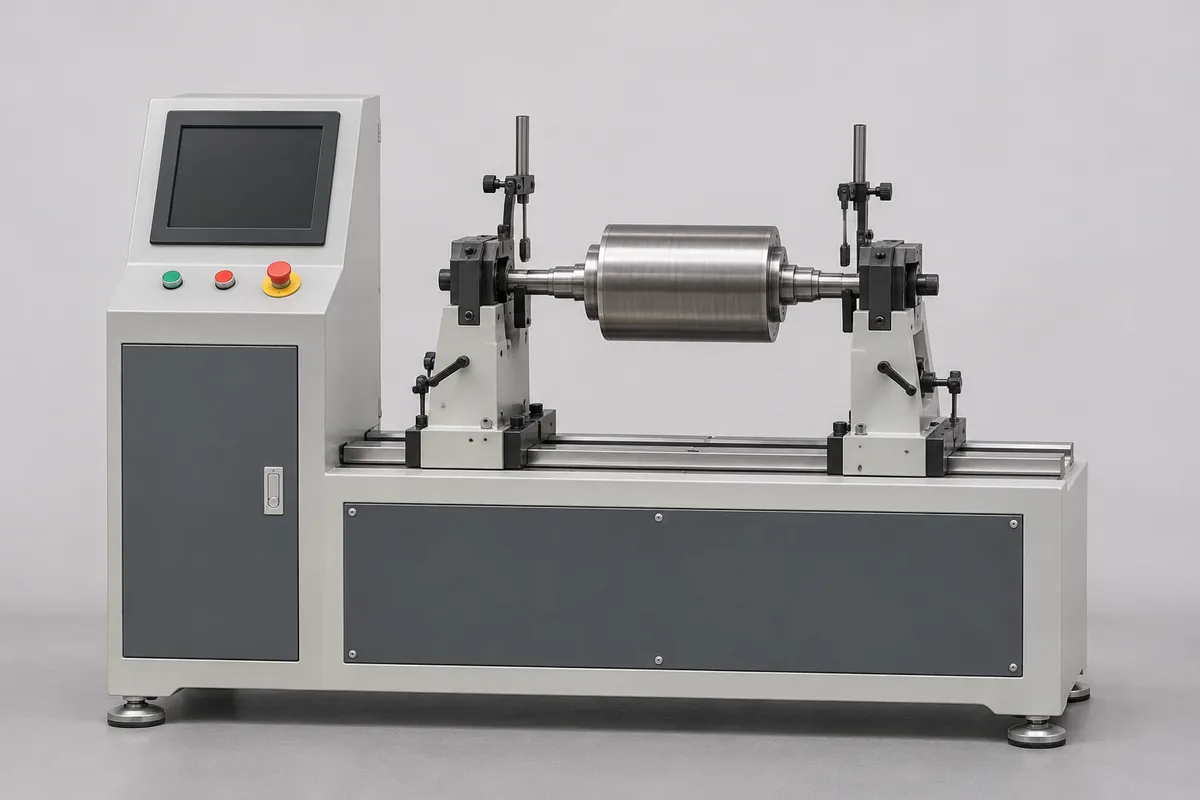
- Schenck Pasio 15 is a horizontal balancing machine. The rotor carried during verification should represent the plant application.
- What we check
- Run a proving rotor with a known trial mass attached at a measured radius. Compare the reported magnitude and angular position in each correction plane.
- Reference equipment and accuracy
- Use an identified rotor, calibrated trial weights and a traceable radius measurement. Their combined contribution in g·mm must be small against the permitted residual unbalance.
- When to repeat the check
- Repeat verification after work on the spindle, bearings, supports or measuring electronics. Keep a regular proving-rotor record for each setup.
Technical references Schenck Balancing machine reference