
On this page
Cell output with the assigned readout
For a bare cell, state the rated output and excitation arrangement. For a cell used with a dedicated indicator, give both serial numbers and the units shown. Record whether readings on unloading are used in the process as well as readings as force rises.
If a press display disagrees with a portable reference after a platen has been changed, describe the contact arrangement on both sides of the cell. This can help distinguish the response of the bare cell from its response through the new assembly.
Specifications and service checks
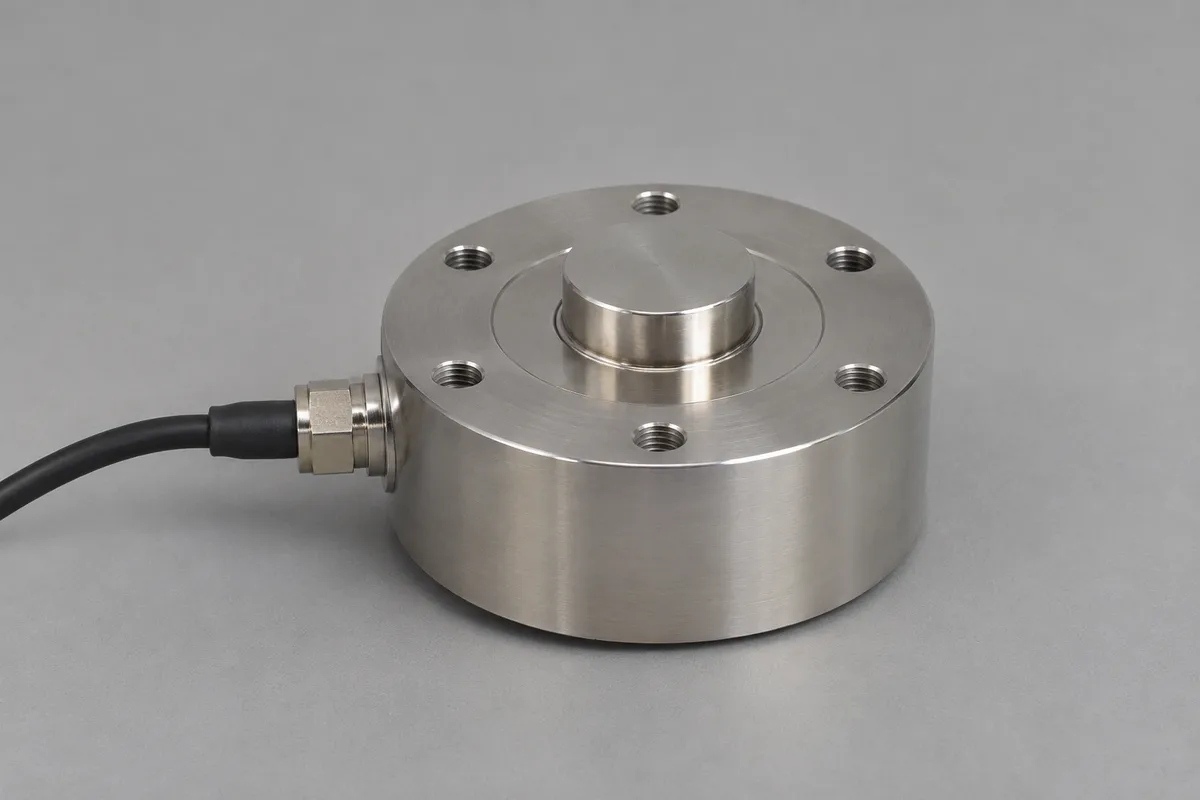
A cell fitted between two flat plates and the same cell used with a spherical seat have different load introductions. A sketch of the real contact faces helps reproduce the assembly when comparing a press reading with another force reference.
- Range and configuration
- HBK’s U10M family includes nominal capacities from 1.25 kN to 1.25 MN. A load cell is chosen for one rated capacity, direction and mounting arrangement.
- Manufacturers and models
- HBK U10M is a tension/compression family. Compression-only designs such as the HBK C10 have different fittings.
- What we check
- Load the cell axially between the specified compression fittings. Repeat the force series after unloading and examine how much the unloaded output has shifted. Record the platen or load button used.
- Reference equipment and accuracy
- Use a traceable force machine or reference transducer of adequate uncertainty. For a force-proving classification, use the loading sequence and performance criteria for the required class.
- When to repeat the check
- Overload, replacement of a readout or changes to load introduction justify another check. Keep the pre-load zero record for cells fitted permanently in a press.
Technical references HBK Compression load cell reference · ISO Force-proving instrument calibration