
On this page
Probe gain and scope termination
Which current probe, amplifier and gain setting do you use, and what termination is selected on the oscilloscope? Include the working current amplitudes and frequencies, with a DC point if required. For pulses, say whether you rely on amplitude, timing or the shape of the waveform.
A scope set for a probe sensitivity of 10 mV/A converts a 100 mV signal to 10 A. A different sensitivity selected on the probe body changes that interpretation. Preserve both the probe setting and the channel’s conversion factor when investigating a scale discrepancy.
Specifications and service checks
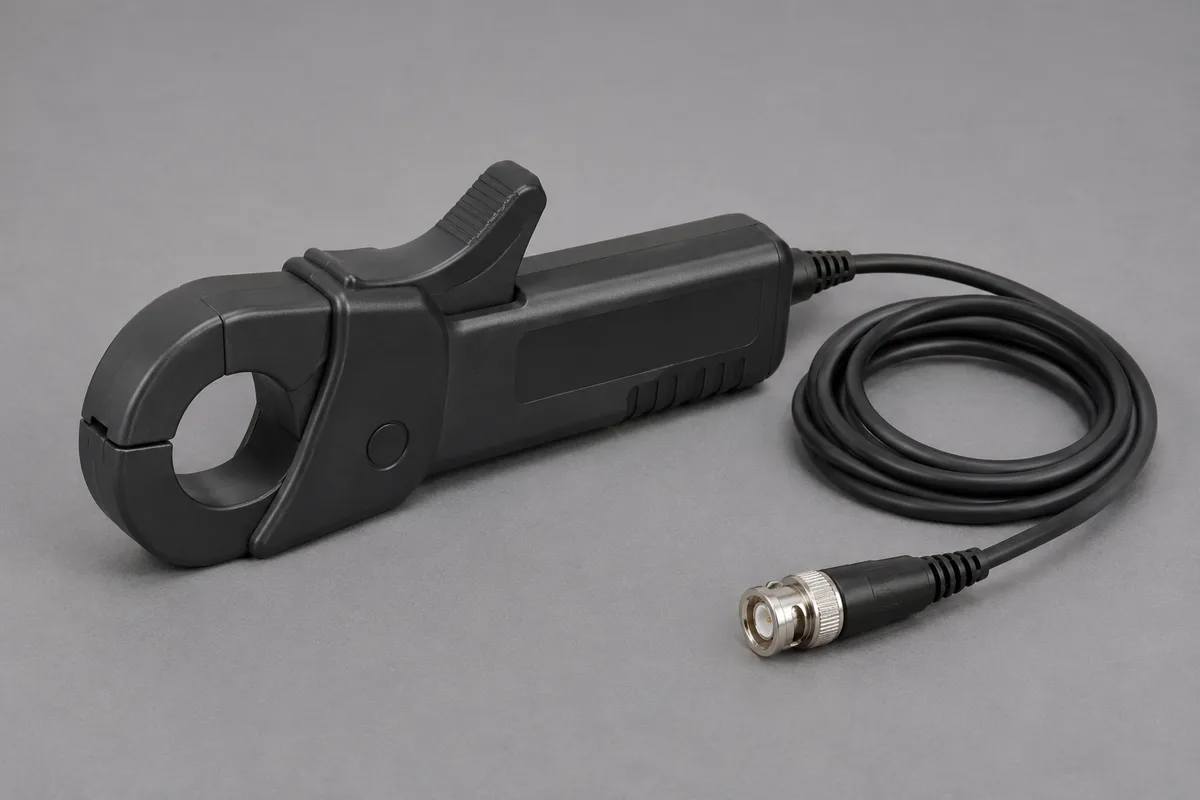
A clamp-on current probe may require zeroing after a large DC current or after changing orientation near a magnetic source. If a zero offset returns when the probe moves, note its position and the coupling mode used by the scope along with the probe model.
- Range and configuration
- Record the range, AC or DC coupling and frequency to be checked. Specifying peak current alone is insufficient for a pulse train.
- Manufacturers and models
- Tektronix TCP0030A has selectable 5 A and 30 A ranges and bandwidth above 120 MHz. The usable current also depends on frequency and waveform.
- What we check
- Compare indicated current against known DC levels and AC signals at selected frequencies. Record the probe's zero condition and orientation.
- Reference equipment and accuracy
- Use a calibrated current reference or characterised current fixture and matched readout. Fixture response and heating become significant at higher current or frequency.
- When to repeat the check
- Verify zero after moving the probe and recheck after jaw damage or an overload.
Technical references 30 A AC/DC Current Probe