
On this page
Signal level and frequency at the terminals
Give the signal amplitude, waveform and frequency range at the terminals. Identify any pulses-per-revolution setting if the meter is scaled from a rotating machine. For a line-frequency indicator, include the nominal operating frequency and both sides of the allowed band.
A frequency display scaled for a pulse source may also show machine speed. If the raw input is 100 pulses per second and the sensor produces two pulses per revolution, the corresponding shaft speed is 3,000 rpm. The pulse count per revolution belongs with the frequency setting when both scales are checked.
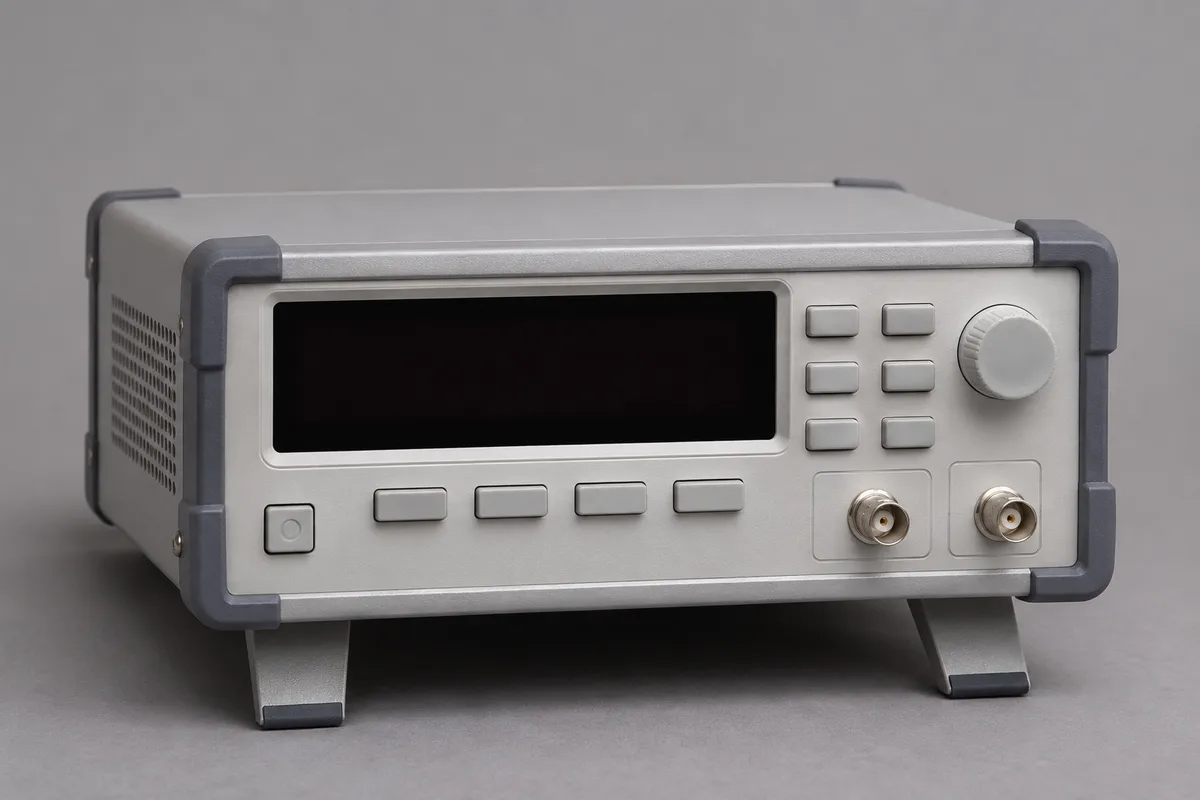
A frequency display fitted to a panel
Give the input rating and the displayed unit, then list the frequencies that the operator reads. If the meter also requires an auxiliary supply, record that marking separately. A photograph of the model label can resolve variants with the same front display.
For a combined panel meter, mark frequency as the requested function and identify any voltage or current readings that also need results. Before removal, have the site team identify the original panel position and preserve the approved settings. Include the instrument's tag and return panel on the order. Ask for the report to identify the frequency function and the input conditions used.
Specifications and service checks
On a generator display specified at 50 Hz, find out whether the operator needs steady-state frequency or the brief dip when a load is connected. The display averaging time can hide a transient even when the steady frequency reading is accurate.
- Range and configuration
- Specify the actual band on the dial, such as the region around 50 Hz, along with the required input voltage.
- Manufacturers and models
- Rishabh offers vibrating-reed frequency meters for narrow bands around a nominal mains frequency. Electronic frequency meters may cover much wider bands.
- What we check
- Apply stable frequencies across the marked band at an appropriate voltage. For a reed meter, record which reed gives the greatest response.
- Reference equipment and accuracy
- Use a frequency source checked against a traceable timebase. The source voltage must reliably drive the indication throughout the test.
- When to repeat the check
- Review after mechanical shock or a change in how sharply individual reeds respond.
Technical references Rishabh vibrating-reed frequency meters