
On this page
What counts as an hour of operation?
Give the start and stop condition, input type and smallest displayed increment. Identify whether the meter counts continuously, only while an input is present, or only above a speed threshold. Record the change in the register over the stated interval.
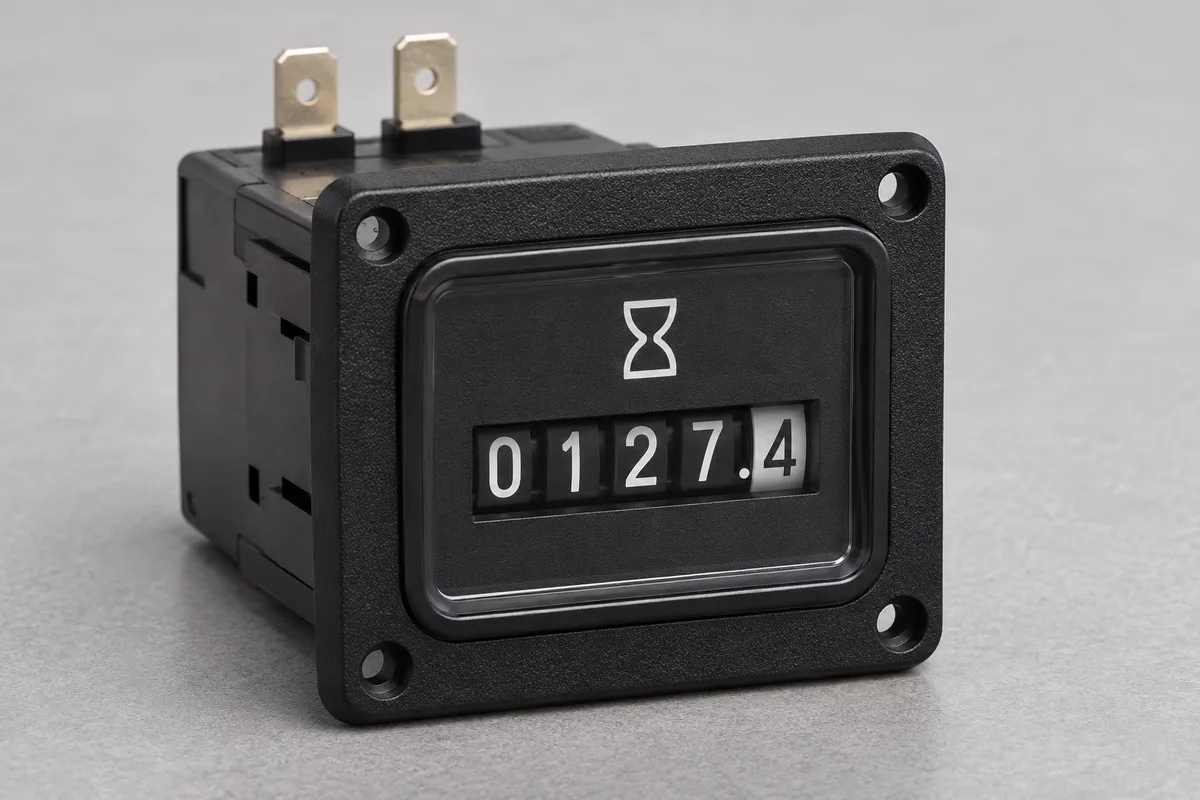
An increment of 0.1 h represents six minutes. If two readings are taken five minutes apart, an unchanged last digit can be consistent with normal operation. Use an interval appropriate to the display resolution when interpreting the observed change.
Specifications and service checks
A forklift meter wired to ignition can accumulate time while the motor is idle. A maintenance schedule based on motor-running hours will then disagree with the register even when elapsed-time measurement is sound. Identify the signal that enables counting.
- Range and configuration
- The least display increment matters. A register that advances in tenths of an hour has a 6-minute step, even if the internal timebase is much finer.
- Manufacturers and models
- Crouzet makes electromechanical elapsed-time counters. Record whether the device counts supply-on time or time gated by a separate input.
- What we check
- Compare change in the register over a sufficiently long reference interval. Check that the run input starts and stops accumulation as intended.
- Reference equipment and accuracy
- Use a traceable timebase or reference timer with an unambiguous start and stop. The display step sets a lower limit to useful test duration.
- When to repeat the check
- Review drift over a long interval and examine the run input after wiring changes.
Technical references Crouzet elapsed-time counters